Is Veolia Water the Solution for Lambertville’s Contaminated Wells?
This blog post can be sponsored by you. Display your link and message here to be seen by local residents and Lambertville area visitors—permanently.
It could cost Lambertville well water residents $25,000 or more per household to connect to city water. Is it worth the price?
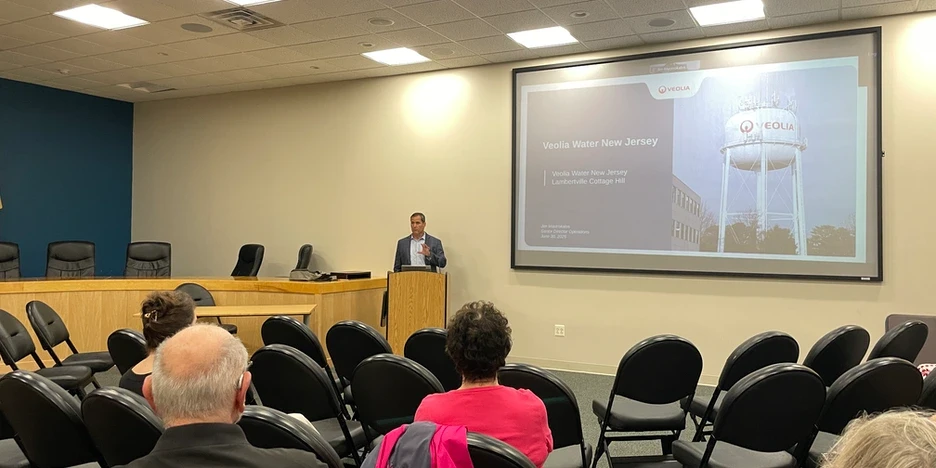
At 7pm on Monday, June 30, 2025, approximately 17 people gathered inside the Phillip L. Pittore Justice Center in Lambertville, NJ. Others attended online.
They were there to hear Jim Mastrokalos, Senior Director of Operations at Veolia Water, present a very early estimate and overview of what it would take, and what it would cost, to connect Cottage Hill residents to the city water grid.
Why City Water?
Residents of Lambertville’s Connaught Hill have found—through the testing of their wells—that the water they are drawing from the ground contains dangerous levels of PFAS, which are also known as “forever chemicals.”
Ingesting forever chemicals is shown to have negative health impacts including reproductive problems, weakening of the body's immune system, disruption of the body’s hormone system, and an increased risk of cancer.
Connaught Hill residents of all ages have been diagnosed with ulcerative colitis as well as testicular, liver, and pancreatic cancers—sometimes with multiplate cases in one household. Many pets in the neighborhood have died from cancer.
Residents on Cottage Hill have begun to test their wells and some have discovered that their water is also contaminated. Of the wells tested in both neighborhoods, over 70 have shown positive for excessive levels of PFAS.
Connaught Hill is home to an old town dump with rubber tires, old appliances, spent building materials, and all kinds of trash left there for decades—and the site was never capped. Nearby, an old factory used Teflon to make electronics parts. Neither site is currently active, but the stains remain.
It’s Complicated
As testing continues, the contaminated area grows. Residents have filed tort claims against the city. Torts are lawsuits designed to get money for damages caused by someone else’s negligence. The city, in turn, hired legal defense.
Meanwhile, Lambertville City Council is trying to figure out the best plan of action for helping citizens, but they have to be careful about what they say and do since many of the residents they are trying to help are now legal opponents.
Impacted citizens want things to move faster, and with more humanity. Some folks are angry at the Mayor, and City Council meetings have been contentious.
There’s a disparity between residents in the effected areas. Some folks can afford the latest home water filtration systems to remove PFAS from their drinking water. Others cannot. Some residents can navigate the paperwork required to apply for grants and assistance. Others are overwhelmed.
Neighbors have banded together, created a communication thread, and they support one another when filling out paperwork and getting estimates for filtration systems. The NJ Spill Act may cover some or all of the expenses for plumbing and installation, but what do residents do in the meantime?
Moving is not a viable option. It’s costly, and getting full price for a house that’s located inside of a contaminated area can be challenging. What’s more, many of the residents have lived in their homes for decades and they want to stay.
City Water vs. Well Water
Water, being a utility, is highly regulated by the government with an intention that its distribution is equitable, affordable, and reliably safe.
City water means the water coming into your home is sourced by a company, and sent to you through pipes under the street. You pay a monthly fee to the water company for your water usage. Downtown Lambertville uses city water.
The water company, which in this case is Veolia, is responsible for providing clean water. They are also responsible for up-keeping the testing equipment and meeting the latest governmental regulatory requirements for acceptable drinking water. Government regulation also keeps prices affordable.
With city water, private residents only need to maintain the plumbing on their own property. The water company maintains the water distribution system.
Well water is often used in rural areas where fewer homes are farther apart, and where the laying of pipes for a centralized water system is cost prohibitive. A well is simply a line drilled deep down into an underground water source.
Some residents in densely populated areas still prefer well water, because they can tap into the Earth and not have to pay a company every month for use.
Just because your neighbor’s well is contaminated doesn’t mean yours will be too. However, if your well tests clean today it doesn’t mean it will stay that way in the future. Wells can run dry, or become contaminated as the result of a natural occurrence, or by human pollution and industrial negligence.
Connecting the Community
Since Lambertville’s polluted area is community-wide, a possible solution is to connect the neighborhood to city water. However, that’s easier said than done.
Some folks can’t afford to pay the cost of installing new pipes and capping their old well. Other residents prefer having their own water source. Not everyone has to connect, but the more people that do, the cheaper the overall cost.
There are potential grants available to help residents defray the costs, but there are a lot of steps to get to the place where residents and the city are in agreement about how to collect and manage those funds.
Is Veolia Water the Answer?
The process for bringing city water to town is that the city and residents have to form a legal entity, request service, receive an estimate, and make a deposit.
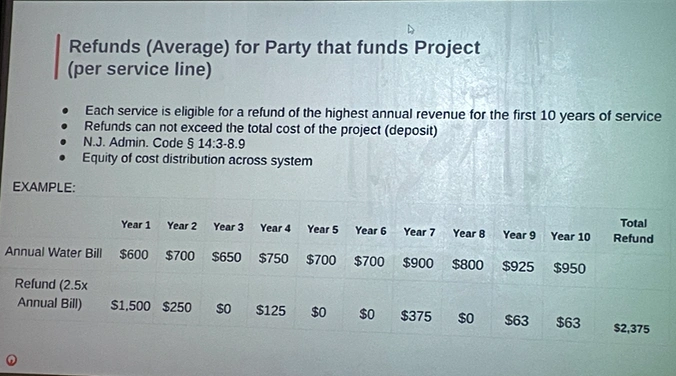
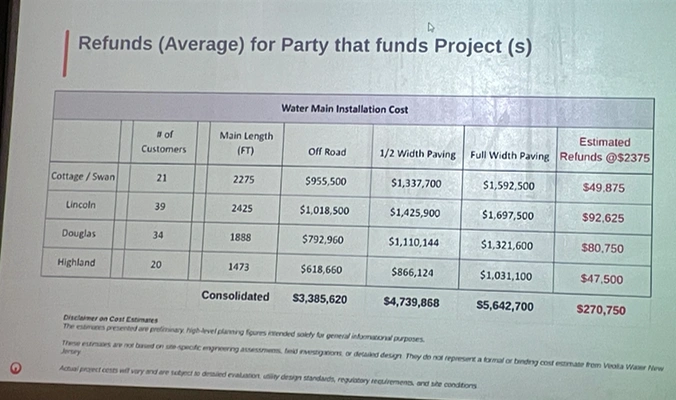
Once the work gets done and the service is activated, the actual price gets reconciled against the estimated price. Revenue monitoring lasts for ten years after the installation, and refunds are based on water use over that time.
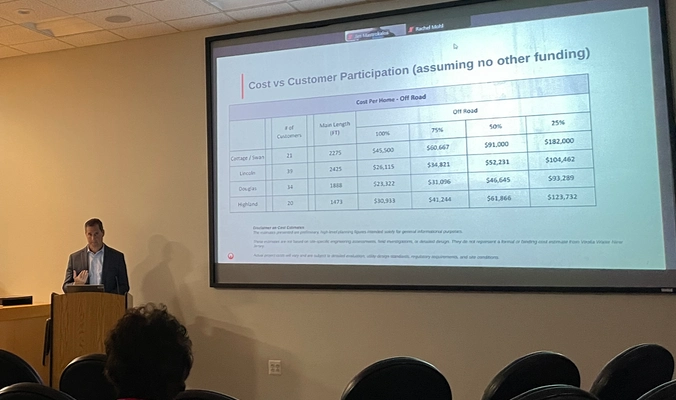
Jim gave several estimates for common scenarios. He clearly communicated that that his presentation was part of a very high-level (meaning don’t hold him to any figures) conversation about connecting effected areas to the water grid.
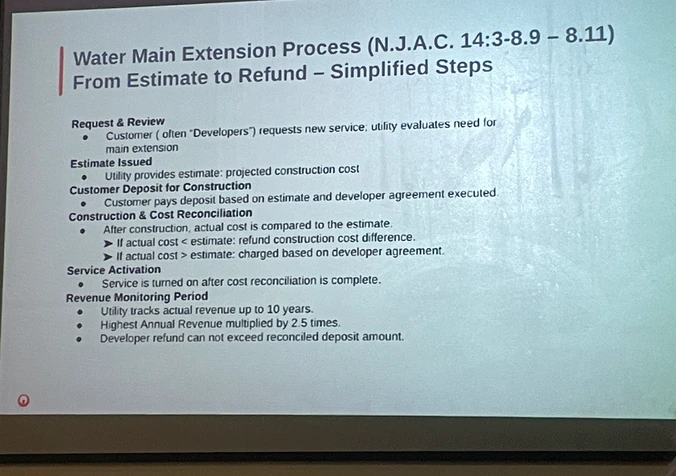
Veolia is regulated by NJ Board of Public Utilities. As such, the water company cannot expand into neighborhoods for the sake of growth. (That’s a good thing. Imagine how our neighborhoods would look if ambitious companies could prospectively run pipes, string wires, bury fiber optic cables, etc.)
When a new development gets built, the developer requests water service to the new houses and the water company extends the grid to serve those homes.
In Lambertville’s case, the city and the residents (in their existing homes) need to act as the “developer,” AKA the entity that requests water service. It would be up to Lambertville citizens and City Council to decide how they’d structure the “developer” entity. The water company won’t move forward without it.
Since the impacted area was not considered a large area by Veolia, it’s likely that they could just install water mains. However, it’s possible that fire hydrants could be included (and possibly required), as well as other necessary infrastructure.
Water Line Responsibilities
The company is responsible for the water mains, which brings piped water to the property line for each residence. From there, it is the responsibility of the property owner to run lines across the yard and into the resident’s house.
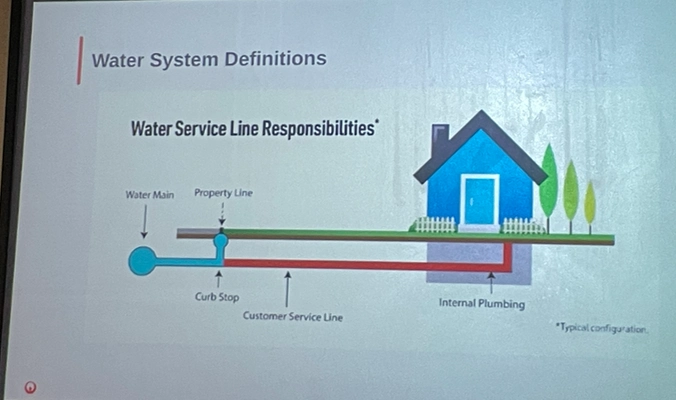
Connecting to city water can be costly. New pipes have to be laid underground, and are often routed through the foundation of the existing home.
Project Scope
Jim created a conceptual map for illustrative purposes. A few attendees got upset, because they didn’t see their house in the highlighted areas, but then were relieved to hear that the map was general, and could be easily updated.
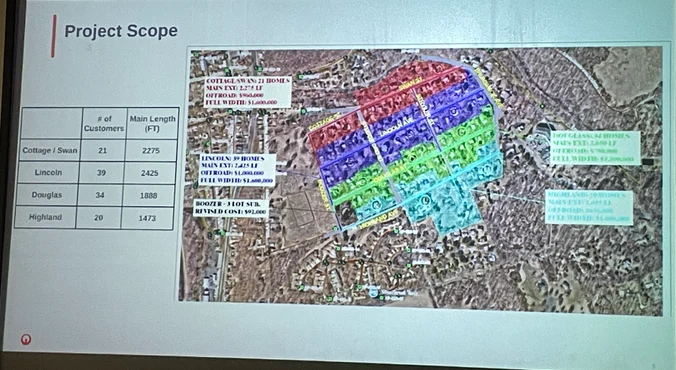
The density of homes varies in the impacted neighborhoods—meaning some streets have more homes than others, and some houses are closer to the street.
Cost Estimate vs. Paving Limits
Pricing varies depending on if the water company can put the water mains in the dirt on the side of the road vs. if they have to rip up asphalt, bury pipes, and patch the road afterwards. If they hit bedrock, there are more considerations.
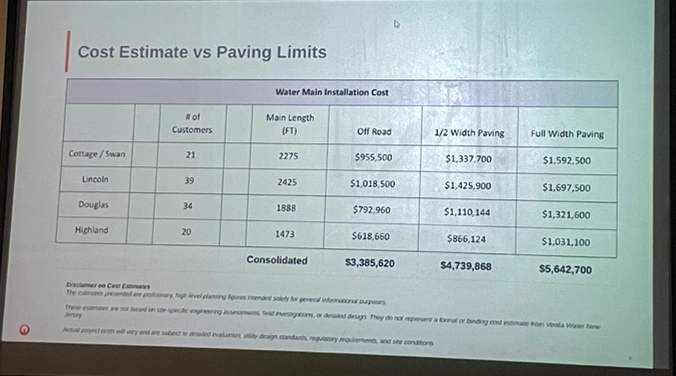
Jim said he tried to show various pricing scenarios. Residents that fund the project get refunds from Veolia through the “developer” entity.
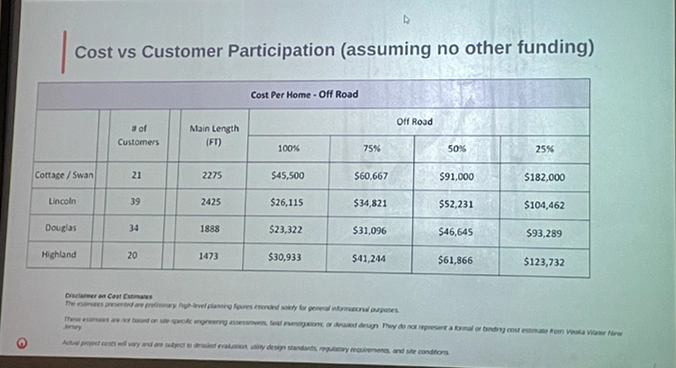
If someone comes in after the installation and says they want city water, their individual refund goes to the “developer” to distribute, instead of the individual.
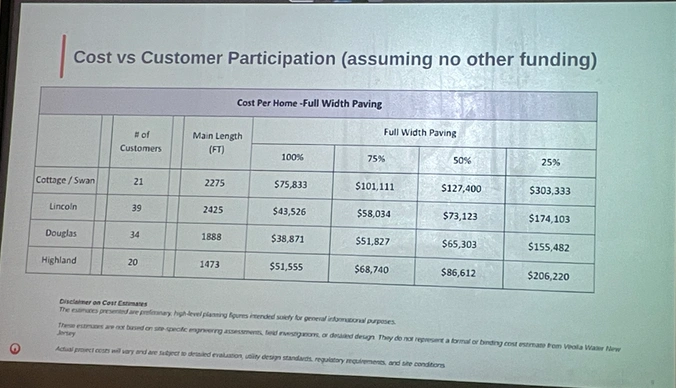
There are grants and funding mechanisms available to potentially fund the entire project, or at least to defeat some of the costs. Veolia is willing to work with the “developer” to put them in a position to receive funding, but it's up to the developer (city and residents) to find and apply for that funding.
Jim said that ‘contaminated ground water’ dictates the possible grants.
“If you have 10 contaminated wells and the next community has 4,000, then they will be first in line for funding,” Jim explained.
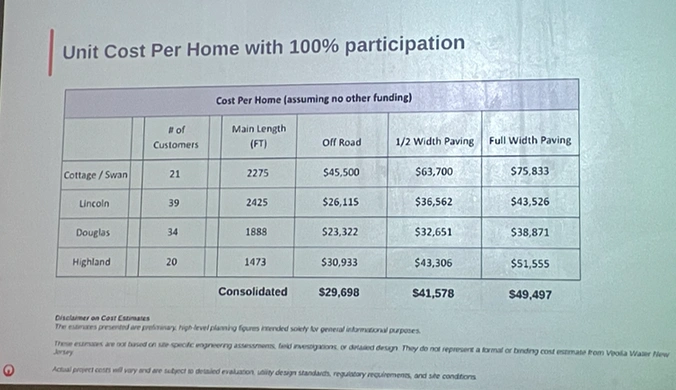
The overall price depends, of course, on how many people want to be connected to city water. The more people that connect, the lower the cost.
It is possible that the NJ Spill Act can help individual residents with the costs of hiring a plumber, running new water lines, and capping old wells.
If a resident connects to city water, it’s possible for the property to keep the well open (for irrigation—although PFAS) as long as the well and the city water are inspected and proven to be two separate systems.
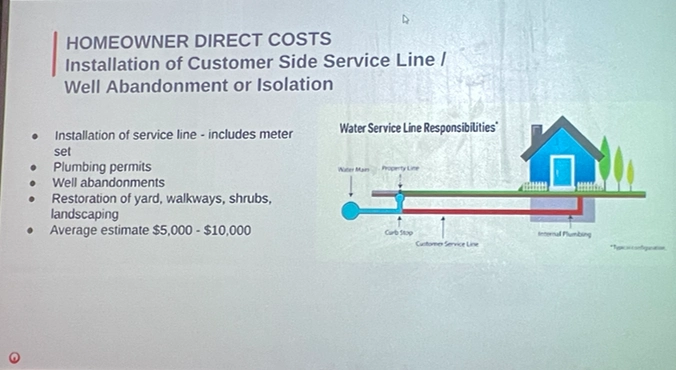
Costs to consider include plumber fees, purchasing a meter, city permits, well capping, digging pipelines, unanticipated supplies, and yard restoration work.
Public Comments
Alexis, who was participating online, said, “Veolia has faced lawsuits and scrutiny for pollution, human rights abuses, and unethical practices world-wide... Does this webinar plan to address Veolia’s well-documented human rights violations? Why should we trust Veolia, and does the city plan to also address these concerns with the public moving forward?”
Jim replied, “I was here to discuss the water main extensions on Cottage Hill. Um, I’m not prepared to discuss or comment on a global entity. If you have any questions, certainly please forward them and we can get you an answer.”
“Thank you,” said Alexis, “I feel like maybe those questions should be addressed prior to discussing the infrastructure plans. I know this isn’t your consideration, Mr. Mastrokalos. I appreciate you being here... if you just google veolia water company human rights violations, a whole slew of things will come up.”
Al from Swan Street said, “I recently did over my well—put in a water filtration system. I have no interest in this water main connect for a number of reasons.
“First of all, I think it's clearly going to cost way above what any homeowner could realistically afford... I’m 72 years old. In 10 years I may be dead.
“My main concern is to keep what I have, utilize water that I can pay for basically on the basis of what I use, and I would guarantee that most of the people on my block feel the same way.
“What I plan on doing is I’ll speak to every member on the street and make sure it doesn't go through. I'm not looking for the rebate. I'm looking for something that I can live here and not have my lawn impeded on in terms of a water main connect—not only running down the center of the street but towards the edges. You know, it will tie up every block here within four blocks, so I'm going to do what I have to do and good luck on your end.”
Jim stuttered through his reply, “I appreciate that Al. I guess I’ve been um, what, what—and I do have some more slides I’d like to go through—what I was attempting do to here, you see up on top is ‘assuming no other funding.’ Like everyone in this room, including me, we work hard everyday. We try to make a living. We try to put food on the table. These are not numbers that are not generally accept—you know, could be tolerated to get water service.”
Just then, a woman in the back of the room stood up and said, “If you’ll excuse me, I’m gonna leave, because I’m on Studdiford Street. Until that is discussed, I’m not included, so...”
The Deputy Clerk pointed out that she was included. Jim scrolled back to the map in his presentation. Residents in attendance showed the woman that her home was, in fact, inside the color-tinted consideration area on the map.
A gentleman in the room said citizens have to chase down an actionable plan rather than seeing a grid of numbers and saying no.
“People might have kids there,” he said, “It’s not just about now. It’s about the sustainability of the communities. What happens if we have a community of homes that can’t be sold?”
Another neighbor asked if the water company is allowed to expand for the sake of health, instead of for the sake of growth.
Jim said they cannot deviate from the municipal code, and that they have to work and collaborate with the regulator.
Councilman Stegman was present. He asked if Jim had done a similar presentation for Connaught Hill.
Jim said the hydraulic grade line of Cottage Hill is such that they can extend the line and get water there. With Connaught Hill, the hydraulic grade line as it’s currently configured can’t provide water, because it’s too high. They would have to put in other infrastructure improvements to get a grade line like Woodcrest.
“I know there’s another conversation happening on the other side,” Jim said, “a new proposed property by the high school, I guess, or something like that. That would have to be a whole new pressure zone...
“I’m not advocating for anything, but from an engineering perspective, if that existed, then there would be a grade line. Then there would be the ability to provide water over to that, because it’s so much higher.”
Lisa and Diana, who were online, asked, “Why now for this?”
Councilwoman Lambert, who was at the presentation, explained.
“Many wells are above the minimum level of contaminants... The purpose of tonight’s meeting is to address PFAS and water accessibility issues... This is just the first conversation in that step. This is something that Council will continue to be looking at, and not in a narrow way, a siloed way. That’s why this meeting came about.”