Saluting Sarge
This blog post can be sponsored by you. Display your link and message here to be seen by local residents and Lambertville area visitors—permanently.
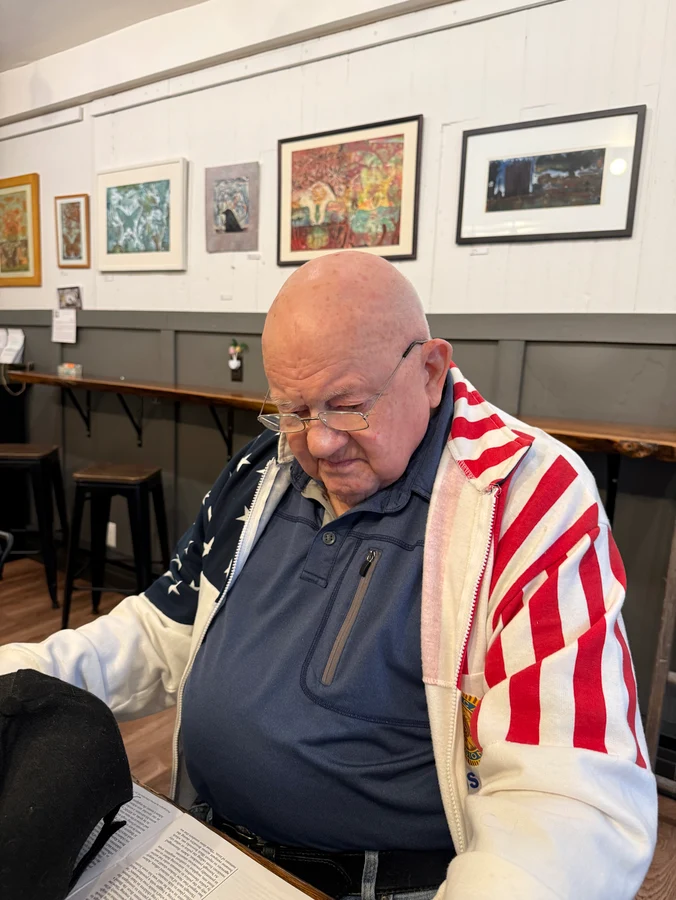
6:35 a.m. Along a quiet street in Lambertville, New Jersey, a man of 91 years emerges from his home. He wears a “Veterans of Korean War” baseball hat and a “Vets of Foreign Wars” jacket, and treads slowly, using his cane for balance and stability, in the direction of North Union Street. Because of a neck injury, he can’t raise his head and looks down most of the time, though he can see peripherally. Often, someone like Sandy Ferris, who’s one of Sarge’s friends, will greet him on the street, offer him her arm and support him until they reach their destination: Union Coffee. Sandy puts it simply: “Sarge is a great guy.”
Sarge is the only customer allowed into Union before it opens at seven a.m. Inside, he moves slowly and deliberately, choosing a magazine from the window ledge and taking it to his usual seat. But not before snatching a couple of napkins to take with him, as is his habit to do; he feels more comfortable having them close by. He sits at the end of a long, wooden, community table in the shop. No one addresses him by his first name.
“Everybody calls me Sarge,” he says.
Even his wife, Olga Rose, calls him Sarge. He became a Sergeant during the Korean War. He was in three branches of the service: the Marines, the Army, and the Air Force. Joining a particular service was more of a function of the recruiter he saw, Sarge says.
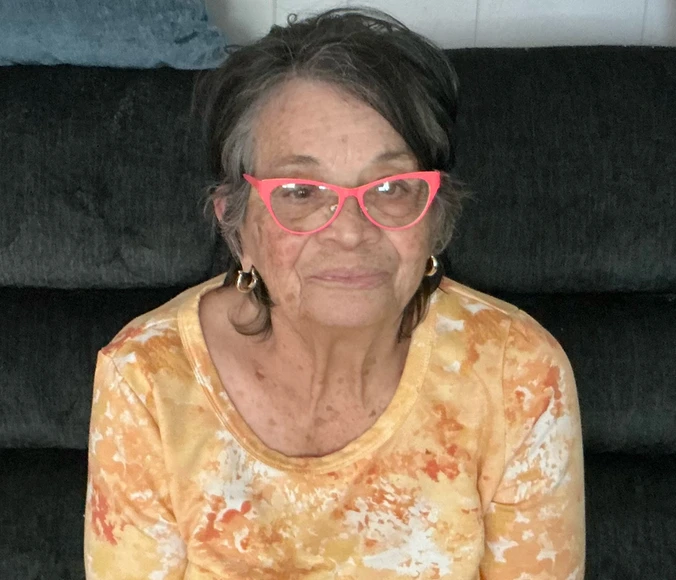
“Everything is the Military” Olga says, describing the orbit of his life. She’s sits on their blue, living room couch in the place they’ve called home for the last twenty years; the same house Olga grew up in.
There are habits from his years in service that stay with him.
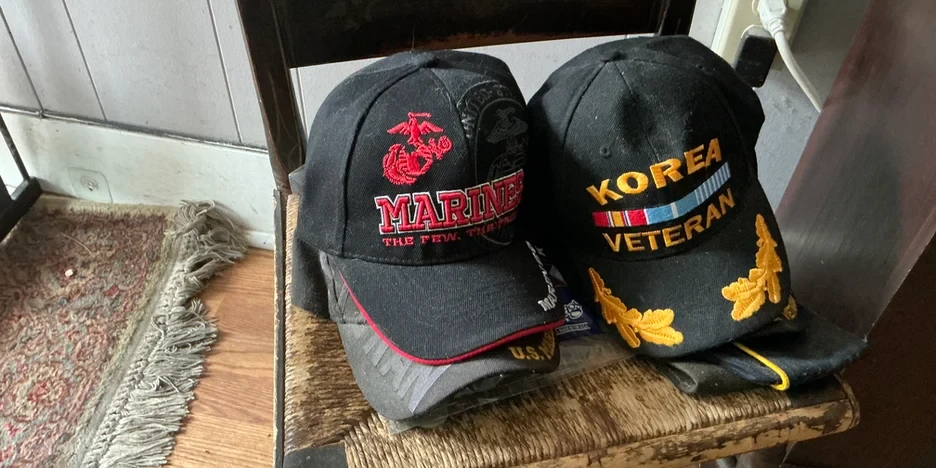
“He presses his jeans everyday,” Olga says, “to have the crease in them, so they look uniform. I have to buy the spray starch because he has to have his crease. He does it because when he was in the military he wore his blues, he had that crease. He wears his Marine hat everyday.”
6:45 a.m. Inside Union, the lights are still off over the seating area, while the baristas prepare for the day. When Sarge sits down, he calls out, depending on whose shift it is, to either Carolyn Gadbois, 41, the owner of Union Coffee or Tyler, 28, its longest-serving employee, or to a barista: “Love ya.” To which they’ll reply, “Love you” or “Love you more.”
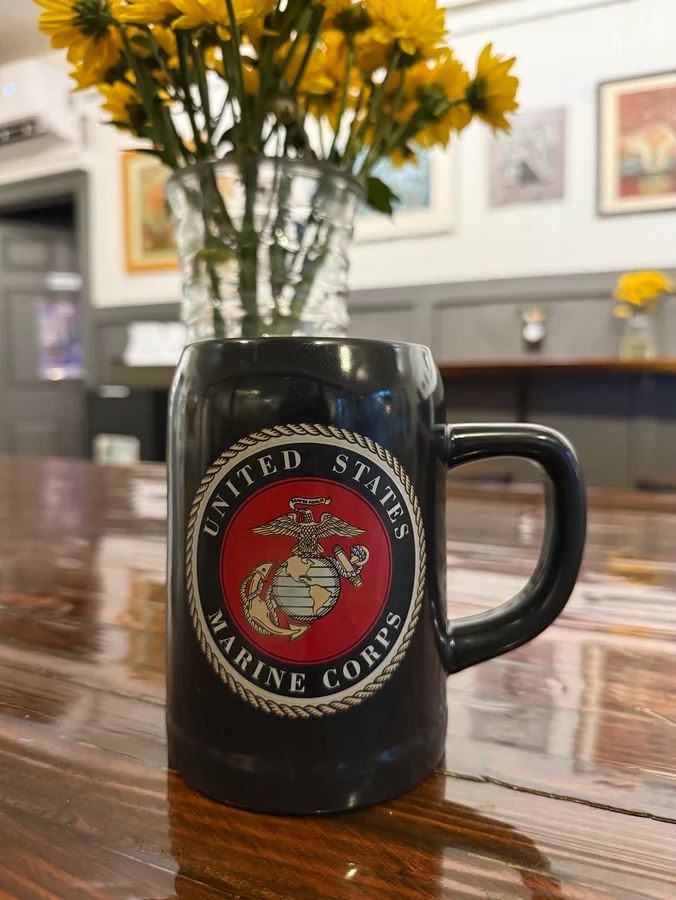
7:00 a.m. Soon, Carolyn or Tyler or a member of the staff will bring Sarge his coffee, in his own Marine Corps mug Carolyn bought for him. The mug illustrates an eagle on top of a globe, which displays the western hemisphere, and an anchor attached to the globe.
“United States Marine Corps” is displayed around the illustration.
They also bring him toast, with either butter or cream cheese. The regulars who sit with him every day—Sandy, Paul, Tony, Peter, Warren, sometimes Joanna—arrive at 7:00 and take their customary seats near Sarge at the table—and the conversation begins. Sample topics include eating, dining, hunting, fishing, travel, politics. There never seems to be a lack of something to talk about.
At his home about a block away from Union, Sarge sits on a green E-Z boy-type chair, with a red, white, and blue Marine Corps blanket draped against the top. The Roses’ dog, Sophie, jumps up on the couch, and gets admonished by Sarge and Olga to stay down. Olga wears an orange and white blouse, pants, and a pair of hip orange-pink eyeglasses.
Olga says, “The Stars and Stripes has to be out, too. He’s always talking about the service. Everything’s military.”
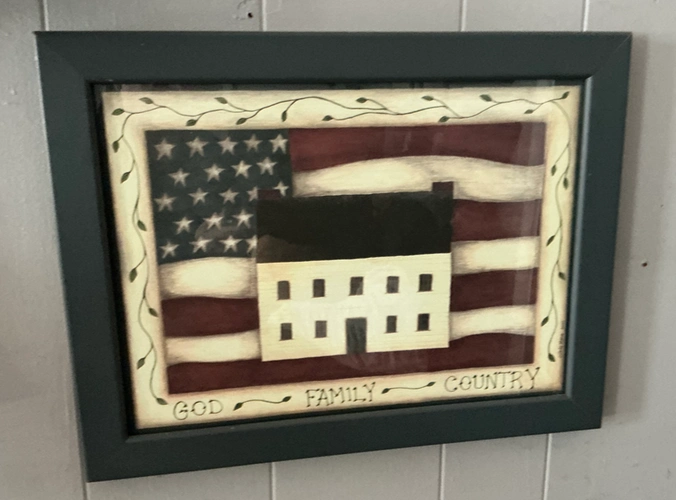
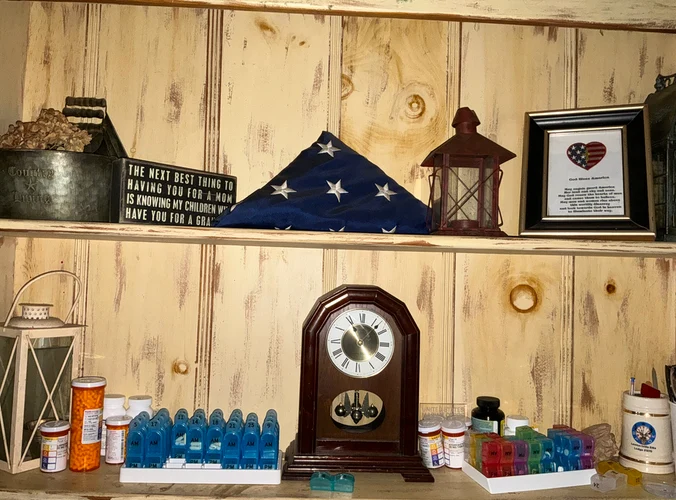
On the wall, a painting of a U.S. flag, a white house laid on top of the flag. Below, on its frame, is printed “God. Family. Country.” A folded flag rests on a shelf in a cabinet in the living room. When Sarge’s phone rings, it’s the Marine Corps hymn that plays, loudly.
Sarge is not the only person in his family to join the Marine Corps. Their second son, Robert, wanted to join the Army. He graduated high school in 1992. Sarge offered to send him to college.
“‘Not me, pop.’” Robert said when he was thinking about not going to college. ‘“Hard enough to go through high school. I’m going to the Army.’”
Sarge said, “If you go to the Army, don’t come home,’” meaning, you won’t be welcome in this house if you don’t join the Marines.
Robert went into the Marines.
Stacey O. Rose (Sarge) was born on March 9th 1934 at St. Francis Hospital in Trenton, New Jersey. He grew up in Lambertville, in a house by the river on Lambert Lane. He was raised with two younger sisters and two older brothers, as well as two stepbrothers. All but one are still alive.
His father was a police officer for the Lambertville Police Department, and his mother was a butcher at the Acme, which is no longer in business.
The Roses had a boat and canoe rental right from their backyard. “It was a good business,” Sarge says. “I worked at it, collecting rent for the boats and canoes.”
Sarge wasn’t always the upstanding person he turned out to be. There was a time, when he was young and in Catholic school, where his behavior was unruly.
“His parents,” Olga says, “had to take him out of [Catholic] school. He was so bad they had to put him in public school.”
In high school, there was an incident that today would have gotten him expelled from school, but back then it just got him suspended. The gist of the story is that a teacher told Sarge to bring some books to the second floor. When he got there, the principal told him to bring them back to the first floor. Back and forth and back and forth, this happened several times.
“I took them back up,” Sarge says. “The principal said ‘I told you to bring that back down,’ and gave him some guff. “And I punched him. That’s about it.”
Needless to say, Sarge’s dad wasn’t happy with him. He was suspended.
7:15 a.m. A line forms at the counter. A barista draws from the ice coffee container or hot coffee canisters—or uses the steamer to make a latte,—filling cups, handing them to the customers, collecting money. The hot swish of the steamer pierces the air, as well as the banter and boisterous laughter among the staff behind the counter.
Some women peel off the line after they place their orders. They amble over to Sarge and put their arms around his shoulder and he puts his arm around their waists. They ask him how he’s doing. And, in his gravelly voice, he tells them, “Just fine, darling.” This happens three or four times.
“He’s a charmer,” Carolyn, Union Coffee Shop’s owner, says. She has short, brown hair and a ubiquitous smile. “He knows how to get to you. He’s a sweet guy and he knows how to play the game. He’s got the skills.”
In his living room, Sarge speaks of his time in the service. He joined the Marines three months before he was to graduate high school. “We just figured the Marines were top of the line of the services. We went into the best of the bunch.”
He served in the Korean and Vietnamese Wars.
In Vietnam, he was a gunner on a helicopter. “What can I say,” Sarge explains about his time flying above the fields and jungles of Vietnam. “You’re shooting like hell at the enemy.”
One time their helicopter was in trouble. They were returning from a mission, on their way back to the base. “We radioed ahead, and they said we were clear going in, but we weren’t clear. They shot us down.”
Crippled, the helicopter flew over a hedgerow and they went down. “We lost a co-pilot. And then I saw Butch Shepard standing over me. He was from Lambertville. I knew him since he was knee-high. He’s since passed away.” Sarge was in his 30s when he was in Vietnam. Butch must have been about 18.
Sarge was in pain. He’d been shot above the butt. “You might say Butch saved my life when I got banged up there. He pulled me out of the jungle.”
Because of his injury, Sarge had to spend forty days in Japan in the hospital. Out of those forty days, he was only really laid up for a week. But the Navy hospitals don’t let you leave right away, so he stayed everyday until noon at the hospital, and then “went to town and drank.”
Did Sarge feel invincible? “No, I didn’t feel invincible. I don’t think I’d go back again. All I can tell you is this: war is hell and you don’t want to be there.”
Sarge also recounts—his voice taking on a more somber tone—that Butch is gone now. He had diabetes, lost his leg, and later died from the disease.
There was another time Sarge got injured. They were fighting and shooting, and their helicopter was again shot down and they had to run for a trench. He dove into the ditch, head first, and hit his face against the wall of the trench, against something hard as iron, and it broke his bottom teeth and hurt like crazy. He had to get dentures for his mouth.
Tyler, the longtime barista at Union, says that when Sarge told them this story, they said to him, “Okay, Sarge, that’s a bit of a heavy slice of cake there.”

Many years later, within the last couple of years, Sarge lost his dentures in the canal when he was fishing. Apparently, he was jiggling them in his mouth and they fell into the water.
“I got them,” he says. “I reached in and got them. It was funny, that’s all.”
7:20 a.m. The “Sarge” group is still talking at the table. The shop is filling up now. The large table has more people sitting there, laptops open; there are just two or three seats left. The rest of the tables have patrons at them. Some customers walk around, looking at the back wall, at the art of a single artist, which rotates after several weeks. Peter, one of the “Sarge” group, invariably takes a book out of a brown or plastic bag, and asks if anyone would like to read it. Usually, no one does. It seems Peter is trying to empty his library.
If, as Sarge says, war is hell, he certainly brought a debilitating souvenir of it back from Vietnam: PTSD. Olga remarks, “He spent two tours in Vietnam—he’s got issues with dreams.”
There are things that he’d rather not remember, much less dream about. There were the times when a fellow soldier would be standing next to him and a sniper would shoot the soldier.
Describing the incidents, he says, “When you’re in the hole and your buddy’s next to you and you watch him go down—I don’t even like to think about it. But you keep going. You hate to see it. You’re sorry, but then, again, you’re glad it wasn’t you. It hurts.”
When he came home from the war, he relived some of those moments. If he goes into a deep sleep, no matter where he is, he’ll experience a nightmare.
Olga offers an example. “He had to have rotator cuff surgery a few years ago, and of course they put him under. When he woke up, he was punching the nurses, because that was the fighting he did in Vietnam. He’ll sit there in his armchair, fall asleep, and have a terrible nightmare.
“It’s because of what happened in the service. His helicopter got shot down, and he lost a couple of his guys.”
Olga recalls that a few times the grandkids have been over when this happens. The grand kids “look at him strange, so I take the kids away until he comes out of it.”
Olga has been fighting with Sarge for years but he refuses to go to the VA for help with PTSD.
“They don’t owe me anything,” he says.
Olga believes he’s entitled to receive care from them, but he won’t ask for it.
Sarge feels he’d be taking something from the government that others, more needy, deserve.
***
When Sarge came home from Vietnam, he had “the best duty I ever had.”
His new job was being a recruiting sergeant in New Jersey. He was living at home and had a government car. He covered the northern part of the state. He worked that job until the day he got out, three or four years later, going into high schools, trying to recruit students.
“That’s your best source of recruits,” he says, leaning back in his armchair. “We went to auditoriums and spoke to them. It was good duty.”
7:50 a.m. It’s getting time for the “Sarge” table to think about leaving. Plates and garbage get deposited in their respective bins. Every day Sarge is escorted home by Sandy or Peter, or Carolyn or Tyler, unless one of the baristas wants to, which they often do. Sarge grabs his cane, gets off his chair, and moves to the cashier. Often, he gets something to take home to his wife. People in line recognize Sarge and say hello. He slowly walks out the door and down the steps. Once outside, he clasps the forearm of whoever’s walking him, and they make the way to his street.
Whether he knows it or not, Sarge plays a vital role in Union.
“He’s the beating heart of our morning,” Carolyn Gadbois, proprietor of Union, says.
If you spend any time at the coffee shop, you realize there’s a special feeling there. It’s more than politeness, and it’s exemplified by Union’s staff’s attitude towards Sarge.
“When I hire someone,” Carolyn says. “I always say this: it’s about the people before it’s about the coffee.” She wants a space that’s welcoming to all people.
She believes that community in small town like Lambertville can be like this. Born and raised here, Sarge’s last name is literally etched in the pavement throughout town. “There are stones reading “Rose” all over town that his brother laid years ago.”
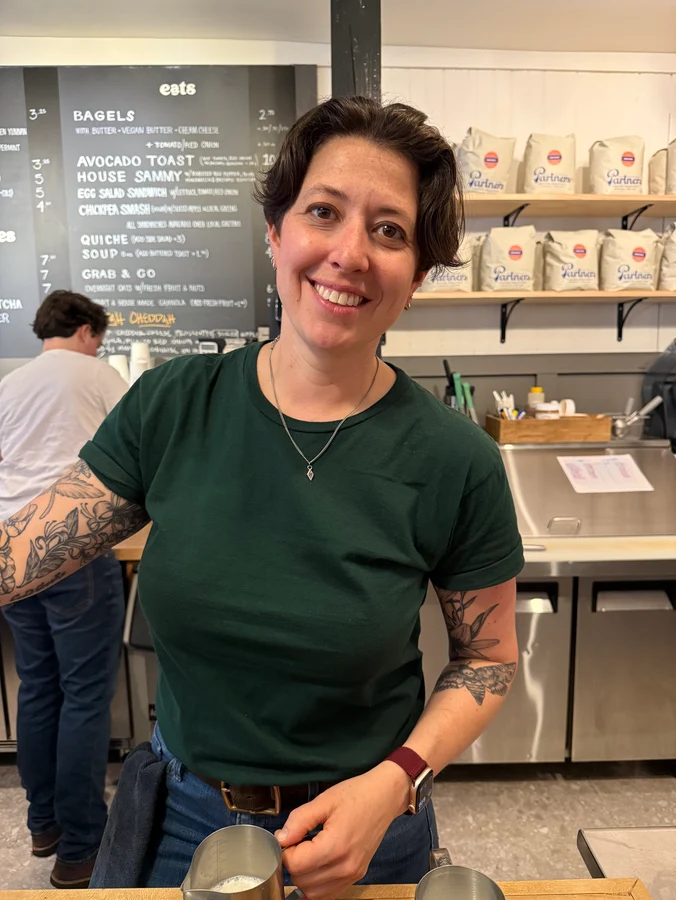
Carolyn adds that when you’re part of a community, like this, it calls for an enormous amount of “understanding and patience and a sense you have to choose to come back to the table with one another, regardless.” She folds her hands in her lap and smiles.
Sarge is a big part of that community. She came to realize that Sarge had real “value” to the shop, that, “It was very touching to see 20 year olds say, ‘Can I walk Sarge home?’ and chat with him.”
It’s the type of thing that will stay with them for the remainder of their lives, she believes.
Carolyn’s own relationship with Sarge is rooted in her own family. “I have a connection with Sarge. My grandfather’s a Marine Vet. My grandfather is a 102 and served in World War II, when Sarge started coming in, it was a way for me to connect with him, as a surrogate for my grandfather.”
It seems that many of the people who have a relationship with Sarge do so because they have someone in their life that is similar to him. And many develop a relationship now.
Alan Durse, a young barista at Union Coffee, worked there when he was home from community college last year. But, “When I went away,” he says, “I was looking forward all semester to coming back to see Sarge. He was just a nice part of the morning routine.”
There are several people who enjoy a special relationship with Sarge. Too many to list here. But another one is Tyler, who’s worked at Union since its inception.
Tyler Klimuk, who wears their dark hair up or under a kerchief, met Sarge at Union, in April 2021, roughly a month after the shop opened. They were a little afraid of him at first, “because he’s a war veteran and he’s got a deep voice and he seemed big and a little scary. It took months of him calling out, ‘Morning, sweetheart, I love you.’ And we slowly started to develop this flirty little friendship. It feels like I’m conversing with an old gentleman, not like a creepy old man.”
Tyler says he’s always very protective, always offered to help them set up the tables outside in the morning. “He’s one of the most consistent parts of my life right now. And he has been for the last four years.”
Theirs is not exactly a grandparent/granddaughter relationship because it’s not that close, Tyler reflects. “‘In another life,’ I tell him, ‘you and me would have been causing trouble all over the country.’” They add, “I tell him, ‘I’m going to find you in a next life and we’re going to have a great time.”
Tyler brings up their own grandparents, who died when Tyler was younger. They didn’t have a relationship with them. “It’s such an interesting connection there [with Sarge]. It’s something I never really had with anybody in my life. I don’t think I had the opportunity to be friends with somebody as old as Sarge, and it’s an interesting dynamic.”
Tyler pauses for a moment, mulling it over, like there’s something further they want to impart. Then, they say, “Sarge likes to get in trouble a lot. And he likes to get me in trouble a lot. So, there was this one time…”
Sarge came in with a hangover, two or three years ago. He wanted a raw egg for his coffee. He said he’d had a little too much to drink. Tyler obliged, “whisking an egg into his coffee.”
Later, Carolyn told them to never even think about doing that again, and also scolded Sarge to not ask that of her employees.
“And he comes over to me,” Tyler says, “and he says ‘Sweetheart, I’m really sorry I got you in trouble.’”
They weren’t angry with him.
In fact, there’s a more touching side to Sarge’s presence at Union, one that involves his various interactions with people. You might say that Sarge and Union are a microcosm of small town America.
Tyler observes a certain grace in seeing many in the community embrace Sarge, offer to walk him home, drive him places (even though he’s still driving himself around), and hang out with him.
And there’s another part to Sarge’s life: people recognize him for his service. Since he wears his regalia all of the time, it’s easy to spot his “Veteran of the War in Korea” hat and see that he’s a war veteran. People are always thanking him for his service.
Once in a restaurant, Sarge asked for the bill. When the server came, it wasn’t the bill that he received but a note instead.
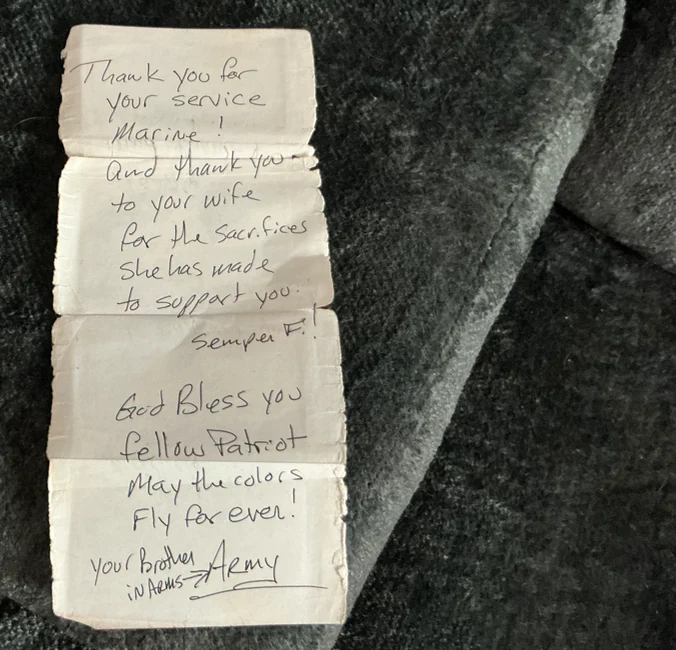
“Thank you for your service, Marine! And thank your wife for the sacrifices she made to support you. Semper Fi! [Always faithful—motto of the U.S. Marine Corps.] God bless you, patriot. May the colors fly for ever. Your brother in arms→Army.” The admirer had paid his bill.
7:55 a.m. Sarge gets up, puts his hand on his cane. On this particular day, Peter is going to walk Sarge home. He’s been a friend to Sarge since the days when Fred’s, another coffee shop, was open in New Hope. (Sarge was such a regular there and so trusted, they gave him the keys to open and get things started in the morning.) Whenever Peter and his wife Ellen are traveling, he makes sure to phone Sarge and check in with him, phoning him every couple of days.
They stop and talk with customers and friends just outside Union, also about to depart.
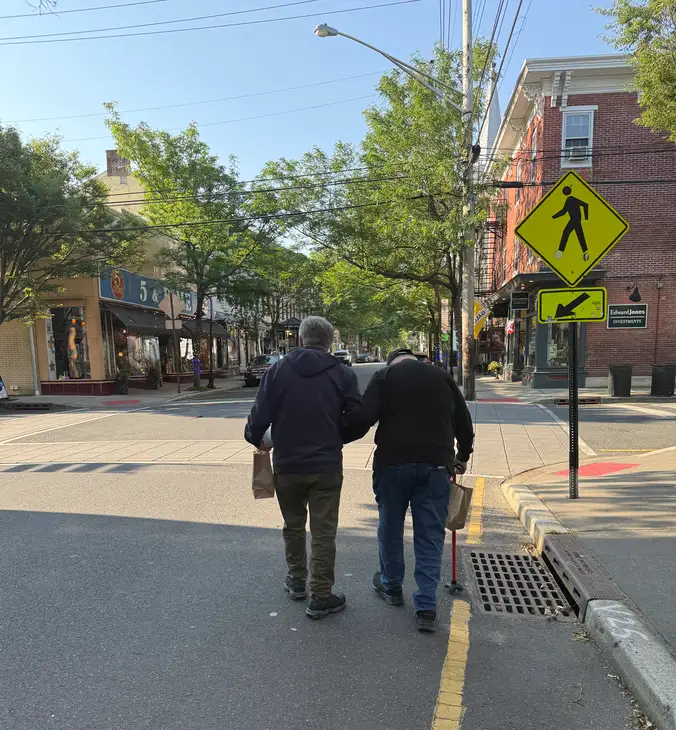
As Peter and Sarge cross Union Street, cars slow down and stop to allow them to pass. They continue to speak to each other as they head to Sarge’s home. It will all begin again tomorrow morning. Sarge will arrive amid setting out of bagels, heating up of croissants, brewing of coffee, and the talking to old and new friends at Union will begin. But for Sarge, it’s not an ephemeral exercise; the connections endure.