Planning Board Meeting: July 2, 2025
This blog post can be sponsored by you. Display your link and message here to be seen by local residents and Lambertville area visitors—permanently.
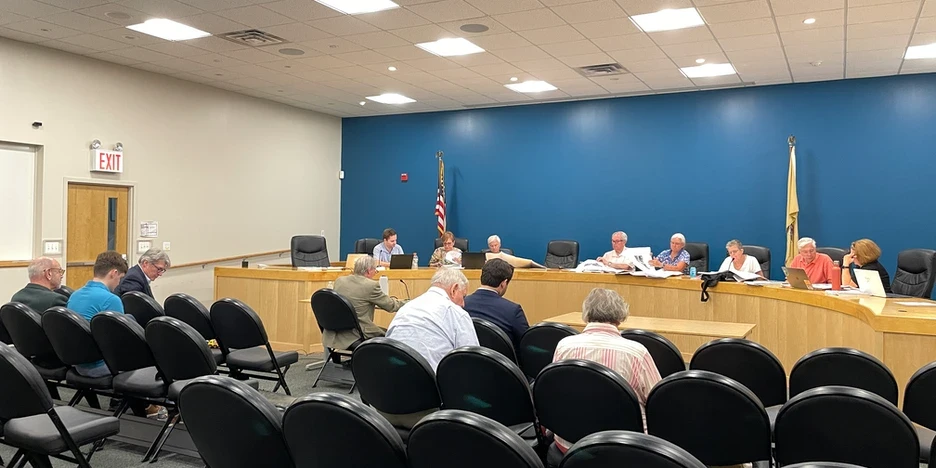
The Lambertville Planning Board met on July 2, 2025. Two proposals were discussed, but only one was challenged.
Public Parking Lot
A proposal was heard for the reconstruction of various elements at 14 N. Union, which is a public parking lot located in the Central Business District.
The proposal included the reconstruction of retaining walls, improved lighting, new signage, a bench, new plantings, a rain garden, and a rain guard.
Property owners within 200 feet of the proposed project were reported to have been notified on May 20, 2025.
It was said that the proposal conforms to the bulk zoning requirements.
There will be planters with decorative paving, granite, brick, a bench, and a way-finding map. They will replace the current publicly displayed map with a new city map. The signage will go through the Historic Preservation Commission.
An abandoned pedestal that used to have a bicycle sculpture on it will be removed. They also plan to reconstruct the brick planters. A four foot brick wall will create a visual barrier between the lot and street to create a sitting area.
New pavers will be bluestone, all surrounded by a granite paving system. They will coordinate with Lambertville Goes Wild to choose appropriate plantings.
The parking lot itself will not be changed.
A board member asked if there has been any consideration for making surfaces more porous. The project actually reduces impervious coverage by design.
Trees that are there will be taken out and replanted, because there is no way to rebuild the brick walls without damaging the trees. If possible, they will keep the trees, but too often the required work damages the roots, and the trees don’t last long after construction. They will plant 8’ to 10’ tall trees.
A board member asked who will water and maintain the plantings, and care for the trees? It was said that the city will maintain the plantings, and that Lambertville Goes Wild might do it. The rain garden was anticipated to require very little maintenance. Trees, once established, were also expected to require little maintenance.
The board said the city should maintain it, or have a plan for maintaining it, rather than relying on volunteers. The only hose nearby is on an adjoining property.
John H. from Quarry Street asked if it’s possible to put up a sign directing people to public restrooms. He said the city should provide public restrooms, and wondered if there was a way to incorporate signage that refers people to those restrooms as a public service.
The board said maybe there could be some consideration, but the person presenting the proposal pointed out that the topic of public restrooms was outside of the scope of the proposal’s conversation.
There were no further comments from the public.
The board recommended that the proposal is to be reviewed by the Shade Tree Commission, Parks and Recreation, and the Environmental Commission. The board also recommended that the questions about maintenance responsibility, and what the watering capabilities are in the area, should be answered.
A motion was made to move forward with the recommendations. The board passed the motion.
Holcombe Farm Redevelopment Plan
Michael Sullivan presented the plan, which provided for limited development on a portion of the Holcombe Farm property. Included in the proposed area is Fisherman’s Mark, which plans an expansion/addition, and six side-by-side or twin affordable units. The six units will replace the affordable housing previously slated for the police station site.
The plan also allows for public access to open space and historic properties, and it preserves historic structures on the property.
5.7 acres of the 8.3 acres in total are open space that are not yet preserved. The city is working on it, and anticipate it will be fine. They have one final requirement, which is to dedicate a roadway to the back of the property, to get the preservation status. The roadway is not a change, it’s already in the plan.
A board members asked about the existing buildings, and if they will expand. Michael said Fisherman’s Mark wants offices and plans for an expansion of their current building. Nothing happens to the stone building.
The Mayor said the smaller barn will likely need to be removed, but that it is not a historic barn. The large barn is an 18th century barn, and that will remain.
Habitat for Humanity is entering into an agreement with the city to build houses where the log cabin home is currently located.
A board member asked why the log cabin can’t remain and be used or reconfigured into two apartments.
The Mayor said he toured the cabin with an architect and engineer, and it is not practical due to the configuration of the building on that site. The plan is to do six units up there.
Michael said Habitat for Humanity uses sweat equity, so retrofitting current construction is not part of their program.
The board asked if Habitat for Humanity will come through the board again, and it was confirmed that they will. They have to submit a conceptual plan that is consistent with the redevelopment plan. They are subject to all the regulations of the city.
Paul asked if the log cabin is manufactured housing—can it be taken apart, sold, or moved?
The Mayor said they haven’t gotten that far, but that it has been discussed.
A board member said it’s a shame to take it down if it can be moved or used elsewhere.
The Mayor agreed.
John H. from Quarry Street made a public comment. He said he was going to read existing documents, and that nothing he was going to say was his opinion.
The board advisor told him that if he was going to be giving expert opinions, he must be sworn in. John read a list of his accomplishments, professional experiences, and history relating to Lambertville. He said he and his wife work from original documents as antiquarians.
John explained that George Washington sat under a tree on the Holcombe Farm and made battle plans.
“We have receipts,” he said.
He said the NJ Historic Preservation Office included the Holcombe Farm as a site on the registry of historic places, and the Library of Congress has Holcombe Farm listed. He said something about how a National Historic Landmark designation has to be applied for verbally, because politics creeped into it.
He said the Holcombe Farm site was cleared for historic designation before it was sold to Lambertville, and that Washington traveled with the Lifeguard Unit on those 8.3 acres.
John read from documents for quite a while. He mentioned the Fair Share Housing blog, defined the meaning of the term “blight,” mentioned how City Council refused to consider encroachment, and said that the property is on the state and national register.
“This property is not eligible for what is being proposed at all,” John concluded.
“It has to go through the Historic Commission. This is an oversight over three administrations. Can you see affordable housing on Monmouth Battlefield? It should go before the Historic Sites Council.”
John explained that there is a property in Lambertville near Quarry Street, and the owners want to have affordable housing on it.
“They want to do tiny houses. They want to do something like Tiny House Nation. They love the concept.”
John stated that none of what he said was his opinion. He mentioned that he and his wife sat down to come up with ideas [about how to stop the proposed plan for affordable housing on that site].
“Mrs. Holcombe was a Quaker minister,” he said, suggesting that maybe there was a meeting house there.
He invited anyone who wanted to help, and said they have all the information to put something together for a National Historic Landmark designation.
A board member asked if it’s the house or the whole property.
John said all of the land is protected. Since it’s under public ownership now, a protective law and statute went into effect. He said the historic protections also cover the view, “which includes Village Apartments.”
“This is something that should have never happened this far—at all,” John said.
“How this is going to be handled is ultimately up to the state of New Jersey.”
A board member asked, “When the Closson’s sold this property to the city, is that when this all came about?“
John said yes, and explained that he is more than happy to share anything he has with the board.
He added, “Today is July 2nd, the date the declaration of independence was signed.”
Some board members seemed moved, and asked how this information affected things. They were advised that the board just needs to decide if the plan is not being inconsistent with the master plan.
Paul, the board chair, read the first sentence of Lambertville’s master plan, which referrs to the mission of historic preservation.
“How can we do that if this is illegal?” another board member asked. “Does this proposed plan disturb the historic integrity of the city?”
Michael said the buildings do not disturb the historic preservation.
The board advisor said the first goal of the master plan was about historic preservation, and then he read more of the goals of the plan, which include a wide range of uses, and development, beyond just preserving the historic nature of the city.
“The board doesn’t need to, nor does it have the authority to nix this,” the advisor said.
The board simply needed to vote on wether or not the plan was “not being inconsistent.”
John H. from Quarry Street stood up and said he did not cover all of the NJ state statutes that garner protection of the property. He said the board should, “put this before the Historic Sites Council.”
The board said they don’t have the power to do that.
John kept speaking, even though he was not sworn in and the public comment period was closed. He said he “offers his services free of charge.”
“This should not be here is the bottom line,” John said, before he left. His wife followed close behind him.
The board asked if there was anything in the purchase of the property that they need to know. The board advisor said there was no reason for them to worry about that at this time.
Michael said it’s the responsibility of the individual developers to figure out how to lay stuff out.
The board talked about how the Holcombe House and some of the old barns are in the process of becoming historic sites, but are not yet designated as such.
All the board had to do is determine if the proposed plan is not inconsistent with the master plan.
Michelle, a board member, was worried.
“How can we agree that if we say yes to this that all the things that need to be done will be done? We’re moving something forward without understanding all of it,” she said. “It just to me seems like there’s too many questions.”
The board talked a little more, and established that it cannot make a decision based on hypotheticals. They had to make a decision based on what was there before them.
The motion passed as not being inconsistent with the master plan.
The Meeting Ended
The board announced that there will be no meeting on July 16th. They opened and closed public comments. They paid the bills, unanimously. They adjourned.