Lambertville Zoning Board Meeting: March 26, 2026
This blog post can be sponsored by you. Display your link and message here to be seen by local residents and Lambertville area visitors—permanently.
After 3.5 hours of testimony, questions, and comments, the applicant withdrew the application, but will return in the future.
The Lambertville Zoning Board met at 7:30pm on Thursday, March 26, 2026.
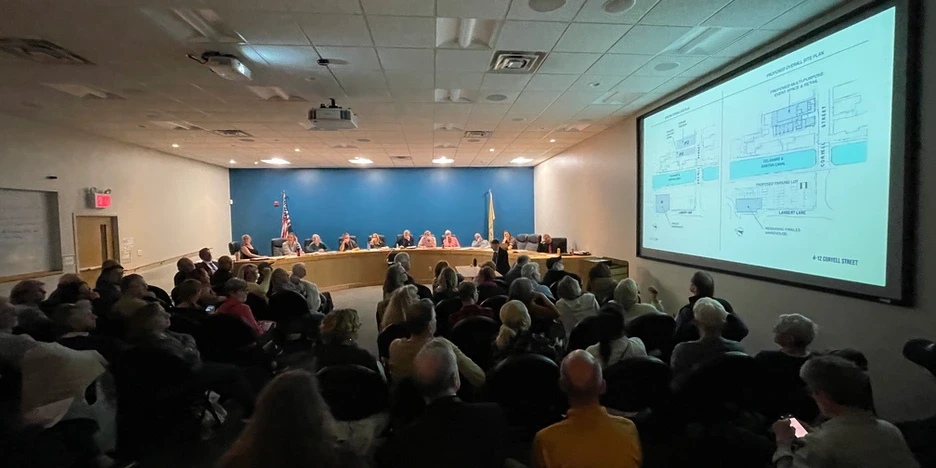
The Pittore Justice Center was completely full with people standing or sitting in the lobby, looking and listening through the open doors.
Board members approved minutes from the previous meeting. Brian Kelly and Sharon Hallanan renewed their oaths.
The board heard an application for 21 Ferry Street, which was a time extension for Block 1044, Lot 8.
The second item was an Approval of Resolution for 72 Delaware Ave., which was a height variance for an existing Accessory Building (for a 2nd floor home gym).
Then they heard an approval resolution for a Steep Slope Variance for a single family home construction project.
All of that took just a few minutes. Then the Zoning Board addressed the application that the crowd of locals came to hear.
Read more about the history of the development of the former Finkles property on Coryell Street in Lambertville, NJ:
New Hope Hospitality Developers Present Lambertville Plan May 12, 2025
Big Mistake Becomes Big Win: Developer Withdraws Coryell Hotel Plans August 21, 2025
Hardware. Hotel. Happiness? A Timeline of Events August 25, 2025
12-14 Coryell Street
Richard Mongelli introduced the applicant (12 Coryell LLC and Lambert Warehouse LLC) who was seeking temporary waivers for things like all-man-made natural features within 200 ft, sanitary feasibility, landscaping, soil, storm water, flood hazard, easements, location size of signs, lighting plan, and the location of the solid waste storage area.
The board asked Doug, the city engineer, to explain temporary waivers. Doug said the applicant did not provide a site plan. If relief was granted, then the applicant would provide site plans for review.
John J. Connors, David Fastiggi, Dave Shropshire, and Justin Auciello—the applicants—were sworn in.
Pat, the Zoning Board Chair, explained how the meeting would go. The board could ask questions. Then, the public could have three minutes for questions and statements. He explained that the issue might be carried until next month, and that the meeting will terminate at 11pm no matter what.
Richard Mongelli introduced 12 Coryell Street as an event space with expansion in the rear and west side of the building. The applicant would use 10 Coryell as an in and out passage by the Porkyard.
Guests would park at 4 Coryell, then walk down the courtyard. He said the warehouse would be kept, but part of it would be removed for parking with the possibility of public parking. He said the applicant was providing more parking spaces than are required.
He gave context that the applicant’s previous site plan encompassed all of the properties for a 3,000 sqft spa, and 175 guest even space. He said his clients listened to people’s feedback, and they want locals to be as excited about the project as they are.
“Spare me,” groaned someone in the audience.
Mongelli continued, citing how there were signs all over town saying “no,” so the applicant went back to the drawing board to create news plans, which were in direct response to the neighbors. As a result, they scaled down the event space and reduced the whole thing.
The Architect
David Fastiggi, architect, presented. He said the applicants were seeking to create a certified rehabilitation.
He described the plan as it is now: retail in back, basement would remain a basement, apartments above. A sales office would front Coryell Street. There would be five EV spaces, and twelve tandem parking spaces. When not in use by The Strand, they’d let the public park in the lot, for a fee, using a public parking app. They plan to use the ally to get guests and pedestrians off of the street.
Someone in the audience called out to ask about parking. The Board Chair reminded everyone that any questions should be saved for at the end.
The applicant said they had “no intentions of holding ceremonies outside.”
Fastiggi said trash would get held inside, then carted down Coryell Street to a trash receptacle in the parking area. He said they’d work with the Lambertville Historical Commission, and they believed they’re working within the guidelines.
“Oh my god,” an audience member muttered.
Another person blurted out, “You’re kidding me.”
Fastiggi showed images on the screen and pointed out how the entrances and theater-marquee-looking awnings were a nod to The Strand, as were the recessed posters and wall sconces shown in the design imagery.
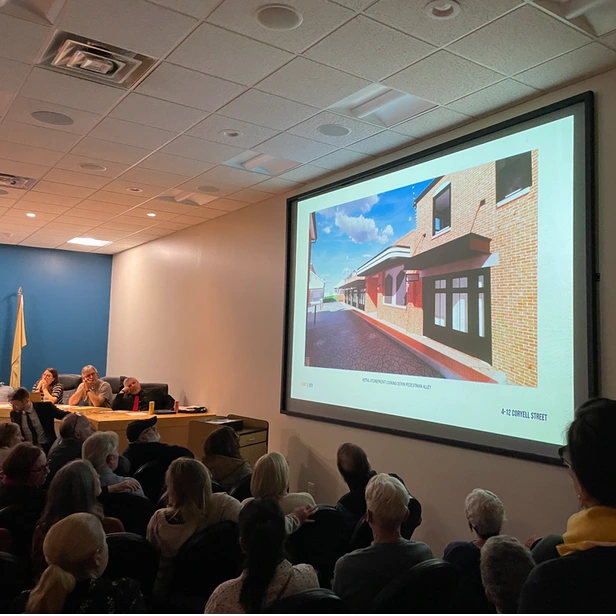
“We feel that we’re proposing a palate of rich textures that modulate and articulate,” Fastiggi said, adding that the applicants felt the design complied with Lambertville’s design guidelines.
He showed side-by-side images of the current conditions juxtaposed with their replacement designs. He spoke about the lighting store and their plan to repair and paint it. He showed design renderings of the facade of The Strand, as they envisioned it, with new doors and windows, new stairs, and ADA-compliant ramp on the sidewalk. The existing cartouches would stay.
He said it honors its historic function and returns the space to a cultural entertainment center that will host a variety of events and experiences that keep it local: comedy nights, art gallery shows, educational seminars.
A resident murmured, “So it’s not a wedding venue anymore?”
The Traffic Study
Dave Shropshire said the traffic study was done. They updated the study as of March 19th, and not much has changed between December and March.
They did counts during weekday times of 7-9 and 4-6. Weekends were done 11-2. They had to evaluate how many cars for this site. They did GRIP generation using data, but he said there was no info in the 12th edition manual for their intended use. However, a category called “banquet hall” was the closest fit.
He said there would be 69-trips-per-hour, and that number of trips is not a significantly high number of trips. He said none of the levels of service changed at any of the intersections as a result of adding that traffic. He said they were conservatively high in their projections, because they were studying for the larger project that was previously proposed.
Shropshire said all levels of service were at a C or better, which meant a 35 second delay. His conclusion was that the project doesn’t have a significant impact from a traffic perspective to the public good related to use variance, and also from a traffic perspective, in his opinion.
The Project Planner
Justin Auciello read a statement about the legacy of The Strand, and said that holding public events honors its historic function, aligns with the plan’s goals, and offers a litany of benefits: culture, community gathering, and commerce.
He said they would do a certified historic rehabilitation and restore the original character of the landmark. He pointed out that The Strand was purpose-built for assembly and entertainment uses. He said the project would strengthen the city’s culture and tourism with movies, performances, and an event space. He said it would enhance local commerce.
“I call them walking wallets,” Auciello said of future patrons at The Strand.
He talked about the requested variances. He outlined the parking lot. He said it would be a multi-purpose event space, which is permitted the CBD.
He mentioned that The Strand was purpose-built for assembly with 17-foot ceiling heights, and for filling 700 seats twice in one evening. He said the warehouse is a non-conforming use in the CBD.
He said The Strand is suited for assembly and cultural activity, and parking is one of the highest practical land uses, and that the public benefits associated with the application were immense, in his opinion. He didn’t see any impacts that would be considered substantial. He said that restaurants and bars have a high turnover, and hotels have more activity with garbage, housekeeping, and deliveries more often. He pointed out that the zone permits other uses that would have a bigger impact on the neighborhood.
Auciello’s lengthy and repetative talking began to fatigue listeners in the room.
“We got it,” someone exclaimed.
Board Questions
🗣️ The City Planner asked about valet parking.
John Connors said guest will self-park and attendants will help people.
The City Planner asked about the parking lot.
John Connors said that on an event day they will turn off the parking app and man the lot with cones, signs, and attendants.
The City Planner asked about loading.
John Connors said van deliveries and pickups can go into the ally, which can accommodate a 24-foot box truck. He said they have a dedicated loading dock area at 7 Coryell (across the street), but they don’t expect deliveries in trucks larger than 28 feet.
The City Planner asked about waste being carted off.
John Connors said they have designated trash and loading area next to the former Finkles store (7 Coryell).
The City Planner asked if the courtyard will be part of programming.
John Connors said the court yard behind The Strand is a passive outdoor space where they will not have ceremonies or live music.
The City Engineer talked about several sections in the application, including a non-conforming preexisting condition, that the buildings at 4 and 10 Coryell do not meet the 10’ property line, that off-track parking means relief is needed, and that the loading and unloading locations are within 300’ of the facility.
🗣️ Filomena asked about traffic trips and what percentage of an increase it was from baseline.
The applicant said they didn’t do a percentage increase, because it didn’t change at all.
Filomena asked about trucks.
The applicant said trucks are so infrequent that it wouldn’t change anything.
🗣️ Brian said traffic sample times were taken in April and May, which are not peak times in town, and he asked that they do a traffic study in the summer months when traffic is higher, and when The Strand would be most active. He was concerned that the traffic survey didn’t reflect accurately, and asked if the applicant has spoken with the police.
The audience clapped, and the Board Chair told everyone not to do that.
Dave Shropshire said they could talk to the police, but he didn’t think it would have any impact.
🗣️ Lee asked how many retail spaces there would be.
John Connors said six spaces, or 2,000 square feet total.
Lee said retail is getting harder and harder in town.
John Connors said even in its undeveloped condition, he already has two leases for retail.
Lee said idea of bringing back The Strand is noble, but she was concerned with volume of people and traffic.
John Connors said they have allotted more parking spaces than they need to.
Lee said five people to a car is unrealistic.
John Connors said for a 150 people venue they have a staff of 12 people maximum.
People in the room laughed audibly.
🗣️ Jane said she would love to see The Strand renovated, but she was concerned about the scale. She said, “If garbage truck is on the street, the street is blocked,” as she expressed concern about the practicality.
John Connors said they are core and shell jobs, and they can internalize most of the construction since they’re not doing cement or tracking mud.
🗣️ Wayne asked what events would happen there.
John Connors said weddings are part of what they’re doing. They can activate the space 4-5 times per week, and he reiterated that The Strand is a shell.
“This is a coring shell in a multi-million dollar renovation,” he said.
John Connors said they’re gonna do weddings on the weekends, and that allows them to support the community activities.
How are you gonna handle people staying over?
John Connors said, “We thought we had that figured out,” referring to their previously proposed hotel plans.
🗣️ Sharon talked about traffic flow.
“When you’re driving on that block, you can’t drive two cars there. It’s like a one way street. The traffic study didn’t talk about that. Especially if valet is active, which will slow it more.”
Dave Shropshire said the intersections were looked at, because that’s where the delays happen.
People in the room muttered “noooo,” because locals know you can’t get two cars at once down Lambertville’s small streets.
“The reality is that, that is what people do,” Shropshire said of waiting for another car to pass, “I did it today, but that doesn’t impact the intersections.”
Sharon said there was no report on impact to pedestrians.
Dave Shropshire said they use computers to generate the information.
Sharron asked about impact of the state park land which the property straddles. She said she wants to see traffic analysis address the foot traffic from bikers and walkers on the towpath, which passes between the parking lot and the proposed project.
John Connors asked, ”What are your concerns are for the canal path?”
Sharon said she was concerned there is an impact there that’s not being addressed.
Dave Shropshire said there are currently two cars per minute, and that adding his traffic just means three cars per minute.
🗣️ Lee said people are part of the impact, and asked about how many events per week were anticipated.
John Connors estimated 4-5 events per week, and suggested they might have movie night one night, comedy the next night, and weddings on the weekend.
🗣️ Kevin wondered if the applicant had done a study to determine how many events make it worth their investment.
John Connors said there would be no valet. He said guests self-park, and an “attendant” takes their keys. He said it’s not going to be hundreds of cars.
“Weddings are family events, and people don’t come alone in one car,” Connors said. People balked, and Connors responded, “You can Google it.”
🗣️ Pat, the Board Chair, asked if 4-5 events is the result of a study.
John Connors said it was “aspirational.” He said banquet events would happen on the weekends, and that it’s a benefit to have trash dumpsters in the area. He said trash haulers come when they can get to the trash, so they’d show up in the off hours.
Pat asked if there is an alcohol license.
John Connors said they will apply for one, or expand their current license.
Pat asked about the kitchen, and wondered about what it would cost for somebody to hold a play at the venue.
John Connors said, “a not-for-profit usually books those kind of events.”
Pat said he hadn’t been inside The Strand since he was a kid, and he asked about the condition inside.
John Connors said it’s a flat-floor shell.
Ten-Minute Break
The meeting paused from 9:30-9:40pm. During that time, a local resident said, “It’s hot in here,” and another resident replied, “There’s a lot of hot air in here.”
Public Questions
🗣️ Holly H. is a property owner in the CBD. She said traffic has gotten over the top in the past five years, and she submitted a collection of traffic photos, which she took in February and March. She has a masters from NYU in construction management, and her concern was the car and truck traffic. She asked the board to walk the site and provide their own traffic study. She also said the applicant’s traffic study was done while the New Hope/Lambertville bridge was closed to two way traffic.
Mangelli noted the common theme of narrowness of Coryell Street, and said they are happy to provide a more robust traffic analysis. He said the applicant is willing to pay for the spots in front of their store so they “can free up space.”
Mongelli also said Coryell Street is very narrow, based on his own experience.
Jeff T. asked, “Are you testifying?”
Mongelli said he was just answering Holly’s questions.
Holly asked how the applicant will impact utilities.
Mongelli said any impacts will have to be paid and addressed by the applicant.
🗣️ Linda W. asked about use variance criteria. How is the parking consistent with master plan? Will loading trucks back onto Coryell? Will the applicant limit loading hours? Will they obtain new counts for summer months? How do tandem parking spots revert to non-tandem, and what about employee parking?
The applicant said the master plan is their guidance.
Shropshire, who did the traffic study, said, “you’re gonna have loading activity, but it’s infrequent.”
🗣️ Cynthia R. is an attorney. She said the Coryell Bridge is due to be repaired in four years and she was concerned about delivery for construction. She asked if the two apartments would be affordable. The applicant said they would not.
She asked more questions. John Connors said construction would last approximately one year, that they would like to beautify the parking area, and that the current train tracks easement is 8 feet from center line of the track.
🗣️ Pam M. G. has an event planning background and wanted to know how many events they’d hold over a weekend. She asked if they planned to hold two events in one day, and pointed out that a morning party and an evening wedding means double deliveries for flowers, catering, etc.
John Connors said the expectation is for one primary event a day, but they might have a small party in the morning and a large event in the evening.
Pam said, “so three major events in a weekend and a couple minor ones.”
🗣️ Jeff T. said they are not applying for a hotel, because a hotel is permitted and so they can go for it any time. He asked if they would put in a deed restriction to prevent a hotel. Richard Mongelli said, “no.”
Jeff asked more questions. The applicant is creating approximately 1.900 sq ft of additional space. John Connors said that building was originally wood frame and is now masonry structure and exterior walls. They intend to install wood sheathing on the outside. Jeff said the structure is a historical trolly shed, but John Connors said there is no evidence of that. Jeff said he’ll send pictures.
Jeff asked how all the retail is gonna work. John didn’t understand the question.
The Board Chair said Jeff’s time had expired, but Jeff had one more question.
“What is the public good?” he asked, because he didn’t hear any benefit for the public at large.
“We’re not here making the argument that what we proposed isn’t publicly beneficial,” the applican said, “ The activation of this space, providing goods and services.”
🗣️ Judy G. said some residents had to leave due to the meeting running so long, and they hoped it would get carried over. She asked how wide the walkway to the Porkyard/Boat House is.
Richard Mongelli said the ally is between 22-23 feet, and there will be emergency exits.
“Aren’t you able to do affordable housing—just to do it?” Judy asked.
“Yes, that’s fair,” said the applicant, agreeing that they could just do it.
🗣️ Rodger J. lives right there and hadn’t seen any photos of what it’s gonna look like. He said he gets a lot of dust and having 80 cars all leaving at 10pm means noise and lights. He asked if they could cover the lights, perhaps with trees. He asked if the trash cans would be enclosed, and how many there would be since there are already three there now.
John Connors said they plan a code-compliant parking lot—paved.
🗣️ Dave B. asked for the maximum amount of cars that can park there.
The answer was 57.
Dave B. said if they have an event for 125 people, they’ll have more than 50 cars with employees. He asked about fire safety, but the applicant didn’t have an answer.
🗣️ Laura M. cited the quote from the applicant’s presentation where they said The Strand would seat “700 people a day, twice a day.” She pointed out that was from the early 1900s. She said she doesn’t see a wedding venue as a cultural venue and invited the applicants to visit Coryell Street on Mother’s Day, Halloween day, or other busy holiday.
“If you live on Union, your mirrors have been hit,” she said, and then asked if a fire truck will fit in the ally.
John Connors said an emergency vehicle can fit.
🗣️ Karen K. said a brewery is going into the Blue Raccoon building, and asked if that was factored in with the traffic study.
The applicant said it was not.
“If traffic study was done when bridge was closed,” she said addressing the board, “how can we accept that traffic study?”
Shropshire said the bridge was open both ways when they did the traffic study. He said he believed the traffic study is completely valid, and no additional information would be gained by doing another study.
🗣️ Steve S. asked if the ally between The Strand and the lighting store would be covered, if they would lose parking, and if that was in the calculation for the big lot. He also asked if the ally between Hamilton Grill and the lighting store would be open to vehicular and pedestrian traffic. The applicant said it would be only for pedestrian traffic, and their parking tally for spaces included retail traffic.
Mongelli confirmed that there will not be valet parking. During events, “attendees” will tell people where to park, and then take their keys. He said the applicant will lose 12 parking spaces during events.
The applicant had identified three loading zones on the property.
Steve S. told the board that there’s an ordinance against the private parking lot.
“Good luck, it’s a tough group,” he joked to the next resident at the podium.
🗣️ Steve H. asked about the hours for the events.
John Connors said they have a hard stop at 10pm.
Steve H. asked if the cars will all all exit onto Coryell Street.
John Connors said the valet will have to be there, so there will be a valet.
Steve H. asked if they will put a fence or wall at the far side of the parking so nobody drives over the edge. John Connors said they would.
🗣️ Stacy H. said a paved parking lot will send water into her house, and asked if can they make it semi-permeable.
John Connors said it will be code-compliant.
Stacy suggested they have valet parking and use a parking lot in another area.
Public Comments
🗣️ Jeff T. said the board had the future of Lambertville in its hands. He said the application should be delayed. The traffic study wasn’t complete.
“A ‘D variance’ is a zone change,” he said. “The founding fathers of this town didn’t want this. No way a private place has any public good. What happened in New Hope will happen here.”
He pointed out, with due respect, that the city engineer and city planner didn’t do enough. Jeff’s voice built to a crescendo.
“The future is in your hands, because D variance stands for destruction!”
Residents applauded.
🗣️ Anne K. asked, “How is this a benefit for the city of Lambertville? How much are you renting the space for? Or are you going for only big money events? Will you set aside specific days for renting?”
Richard Mongelli said you can’t have a historic renovation and not hold the events that pays for it.
Anne asked if there will be certain days set aside [for cultural events].
John Connors said they proposed a wide variety of events: art shows, comedy nights, etc.
Anne asked, “specific nights set aside?”
John said they will have events, but they will be random.
🗣️ Kristen had lived in Lambertville for eight years and has seen business boom in last few years. She said she doesn’t see that they are bringing community space. “Weddings? We don’t need it.” she said.
🗣️ Another resident said there were too many questions about the impact of traffic.
🗣️ Michelle H. requested additional research for the state park path. She said a large fire truck can fit in the ally if you dropped it there from the sky, but there’s no way it can turn into the ally and the commercial kitchen is a fire risk.
🗣️ Jay lives on Coryell and said it’s really loud when trash trucks come by. He was concerned that there will be more noise. He said kids live there.
“People don’t want it, so why keep fighting for it?” he asked the applicant.
🗣️ Amy said there was a jarring lack of human element. She mentioned a year of construction, the environmental impact to the canal, and fear of a person getting hit by the canal path. She felt they offer no public good, and said she has watched the traffic and residents increase over the last six years. She said that the applicant’s estimated 12 employees was downsizing their staffing needs, and she concluded by saying it’s not fair to the people who live here.
🗣️ Evan L. spoke directly to the board and said the data given is not enough for them to make a decision.
“We don’t have enough information. That’s their problem, not your problem,” he said. “They should come with more stuff. No answers for community benefit. Someone asked what it costs to rent. No answer. It shows what they care about—money.”
🗣️ Jesse V. said the gravel lot is a beautiful part of town, and she was concerned about it. She said there was no talk of native plants.
🗣️ Holly H. said consideration should be given that this property is surrounded by residential properties. “This event space impacts an incredible amount of residential properties,” she said.
🗣️ Frank F. thanked zoning board and said, “I don’t see one positive aspect to this project. The traffic: Coryell is 29 feet wide. The average car is 6 feet wide. Mirrors get sheered off. I’m not anti development, I’m anti monster development.”
He said there would be a transformer by his backyard, and requested that the board commission an independent traffic study and that the applicant pay for it.
🗣️ Karen K. thanked the board for staying until 11pm. She said Coryell Street has a history, and not the one we’re being sold, but as a neighborhood. She said the project threatened to choke our town, and Lambertville works because we have a life here.
“That’s why we have zoning. Zoning helps us all work together. It upholds the integrity of our town,” she said.
🗣️ Steve S. was the last person in line to comment, and he simply said he agreed with the previous comments.
Richard Mongelli said the applicant needed to do more work on traffic.
Pat, the Board Chair, polled the board to see if they wanted to make a decision.
Lee said she is not comfortable making a decision.
Filomena made a motion to vote.
Richard Mongelli said he wanted to withdrawal and come back in the future. He called for a time out, and stepped outside into the hall to talk with John Connors. Meanwhile, people in the room called out, “vote!”
Upon return, Richard Mongelli said the applicant was mindful of the concerns from neighbors, so the applicant withdrew and will resubmit at a later time.
Jovial chatter filled the room and people begin to exit.
The board paid the bills, then adjourned.