New Hope Hospitality Developers Present Lambertville Plan

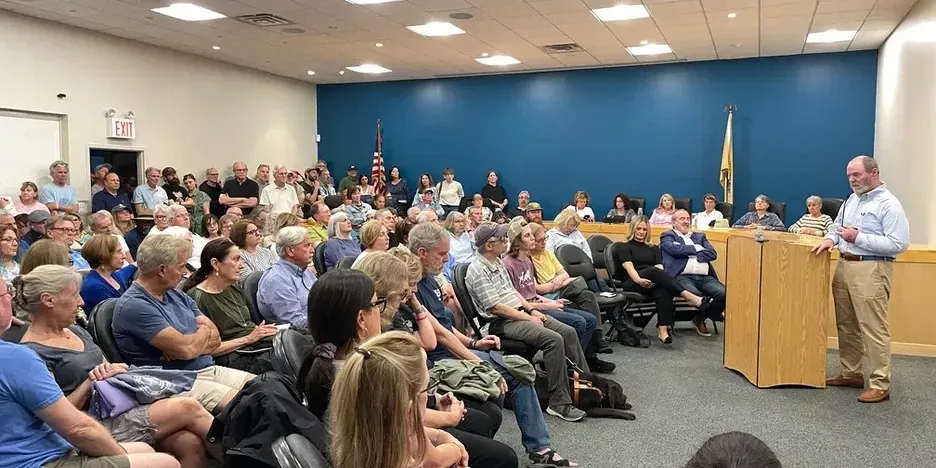
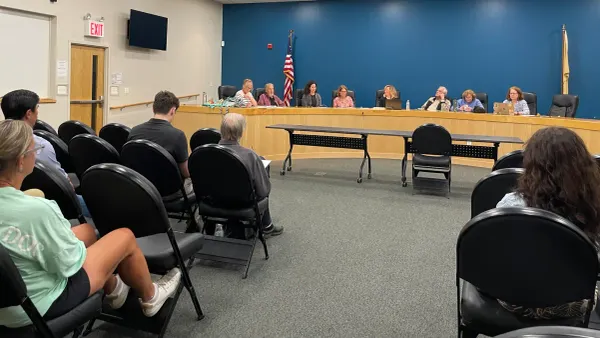
At 7pm on Thursday, May 8, 2025 an informal information meeting was held at the Phillip L. Pittore Justice Center in Lambertville, NJ.
The guests were Ron Gorodesky of Refined Hospitality and John Connors of Brickstone Realty. They came to present their redevelopment plans for the properties at the west end of Coryell Street.
Rumors had been circulating that they wanted to put in a 40-room hotel, wedding venue, and parking garage, which many locals do not want in the center of town.
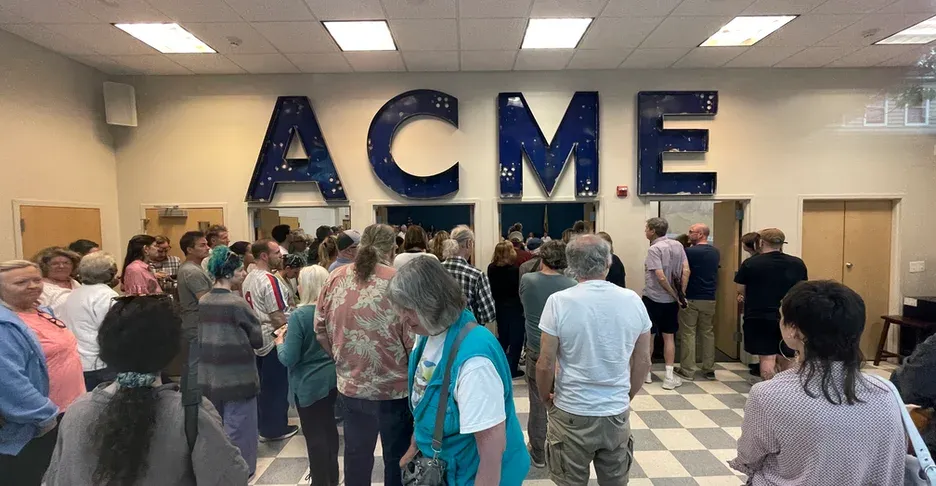
At 7pm, the room was packed with people. Citizens spilled into the lobby where they stood looking through the doors and listening carefully to the presentation as it broadcast over the Pittore Center’s intermittent PA system.
I arrived just after Mayor Nowick introduced the speaker.
“My name is John Connors and my company is Brickstone Realty,” he began.
“We invited you here tonight to introduce ourselves, mainly. Um, and then to address some of the concerns that, um, are rightful concerns that we’ve seen in social media and the local press.”
“And this is something we do routine. This is not unusual. Um, I’d like to note that we haven’t made any submissions yet. This is informational for everybody.”
He continued, “Um, but we find that, it’s good sometimes to sort of tamp down the speculation. There are a million possible outcomes, okay? We hope we’re in the business of giving you the best possible outcome.”
He could have stopped right there, but he didn’t.
Connors, who has been a center city Philadelphia developer since 1986, explained about how he worked on the Lit Brothers building, which had been vacant for seven years. He described it as a “monster certified historic rehabilitation” that his company successfully executed. It was reason to be proud, for sure, but it was not what his audience wanted to hear about.
“Two years later we bought the John Wanamaker building,” he said.
Connors was clearly trying to convey his expertise, but the audience wasn’t there to hear about how he once worked as an investment banker.
Someone interrupted, "Can you speak up a little, please?"
Connors spoke louder for a sentence or two.
His work has centered on placemaking for the past 35 years. He was on the Philly Preservation Alliance, the executive committee for the Convention Center, chairman of board for 10 years in the Center City Business District, etc.
“Who cares?” someone grumbled.
“I’ve been immersed in extraordinary, sensitive, unusual projects for the last forty years,” Connors said.
“I think in many respects I am uniquely qualified.”
Several more people said they couldn’t hear him, with their tone clearly conveying their annoyance.
Connors pressed the mic directly to his lips and said that rehabilitation work was, “the DNA of Brickstone, okay?”
“We are certainly sensitive to, you know, um, everything that makes Lambertville Lambertville, and, the gestalt, if you will.
“That is a combination of history, culture, and built environment. Hopefully you’ll see that we have been sensitive to all of those things. Okay?”
It was like he was giving a master class in real estate developer speak.
“We don’t take these things lightly. We immersed ourselves in your zoning code, your master plan, your design guidelines, and even, frankly, the consideration of individual property owners that are going to be directly impacted. Everything we haven’t though of, I’m sure you’re gonna tell me.”
His approach reminded me of the movie Avatar, the plot of which revolves around a white man who comes to an alien village, quickly masters the ways of the aliens, and then saves them.
Connors introduced Ron Gorodesky of Refined Hospitality, but not formally, as in Gorodesky didn’t stand up.
Connors mentioned how Refined Hospitality had won many awards, and about how he and Gorodesky have been working together on a project in Cape May, NJ for the past several years.
Gorodesky sat in silence, directly beside the podium. His arms and legs remained crossed throughout the presentation.
To his right sat Julie Yeager. Yeager didn’t speak, and wasn’t introduced.
Yeager was the person who—six years ago—said there would be a brief hiatus before a “hotel and restaurant/bar experience… with enhanced amenities for the LGBTQ+ and greater New Hope community” would replace The Raven after they demolished it and turned it into a valet parking lot for River House at Odette’s.
The microphone cut in and out again. People stopped asking and instead started telling Connors to speak louder.
Holding the mic to his lips, and with one hand on the activation button, he finally got into what everyone came to see.
“Okay, so, our plan is called Hotel Coryell,” Connors said, looking at his slide.
“Oh come on!” someone said.
“It consists of the Strand Theater, um, the old Finkles lighting house, Hamilton’s Grill Room, and the Boat House. Okay? That is the essence and inspiration for our hospitality concept, okay?”
Then Connors threw a haymaker.
“We didn’t make this up. This isn’t our idea. A guy named Jim Hamilton identified and created this concept. This is basically his initial concept, we’re just taking it to the next level.”
Connors explained that Trax Partners acquired the properties over about four and a half years.
“You can see they are 4, 6, 8, 10, 12, 14, and 7 Coryell Street. In total they aggregate about an acre and a half. In an urban environment, that is really a special assemblage.”
He continued.
“Having all of those properties under common control is incredibly important—not to us, but to the city of Lambertville. If all eight of those parcels were being developed independently, it would be chaos, okay?
“If you don’t know, Ron and I are now the owners of the Boat House and Hamilton Grill as of August 29th, and, um, we both have a personal history here. We think the Boat House is iconic and forever, and we’re not gonna touch it.
The audience applauded.
“The Boat House is gonna be the Boat House for as long as we have anything to do with it,” Connors said.
Then he introduced Revolution Woodfire Grille, which is the restaurant they’re currently operating in the former Hamilton Grill location.
“That little enclave is really special to us, and we think it’s special to keep together and to give it a new 40-year life.”
The next slide showed their rendition with the street view of a redeveloped Coryell Street.
“Oh god,” a person reacted.
“That is the impact that all of the new development will feel like from the street,” Connors said, “The Strand will have a third floor, but it starts 40 feet back so you can’t see it from the street.”
By adding a third floor to the former Finkles lighting store, and connecting that to the Strand, they planned to internalize many of their operational issues.
“The alley will be rechristened ‘Core Lane.’ It will be animated, there will be planters... mood lighting. It’s gonna be very special,” Connors said.
“It’s totally proportionate and not an overwhelming presence,” Connors explained.
The crowd grumbled.
“Five years from now the goal is you come back here and you won’t be able to tell what was here and what wasn’t. Okay?
“This is just really good urban planning at its best. And what really makes it work is the fact that we’ve been able to solve the parking issue that devils urban development since the history of mankind. So, um, again having all those parcels under common control is what allows this to be done comprehensively where the uses are—”
He didn’t finish his sentence.
“300 feet to the north and you see buildings of the same scale and even taller,” Connors said.
He explained that their design was totally in concert with the master plan and design guidelines.
“I think we have all the right sensitivities and I think that this is going to be nothing but an extraordinary event for the city of Lambertville, okay?
“Our program is as follows, forty-nine new hotel rooms.”
People gulped, “Forty-nine?!”
“The fear was that they were gonna be stacked up in a big building,” Connors continued, “But we spread ’em out, okay? There’s fourteen hotel rooms, you know, over the Strand, and along the alley there’s thirty-five hotel room suites. These are full sized suites along the canal.
“We have a full service spa with seven treatment rooms, steam, sauna, cold plunge, vitality pool. A full service spa, okay?
“And then the last thing is there will be a banquet room in the Strand.
“The Strand was designed and built to be a theater with 700 mahogany opera chairs, according to the internet... We’re proposing not 700 seats, but 175. We have the ability to capture it in our campus, okay?”
He showed an image of the old Finkles warehouse on the canal.
“The biggest—when we looked at social media—the garage is the Bogeyman. It’s kinda just nasty, right?”
“We have a tremendous accident of topography where Lambert Lane is six feet below grade level from Coryell Street. It’s about eight feet four inches. You won’t even see it, okay?”
Connors said that the second floor of the neighboring houses will look over the top level of the parking garage.
“Forty-two cars enter off Lambert Lane, and forty-two cars will enter off Coryell, and they have surface parking all along.
“All in all this is what made it work. This is the special sauce. We’re doing the traffic study right now.
“We know what peak periods are going to be. We can manage the banquet times. We can manage the traffic times so all of these things add up to our ability to manage and master plan this thing. We’re a month to six weeks away from submitting anything.
“We have a lifetime of architects and engineers working on this.
“The bottom line is this is a pretty tight package.
“And I’ve been giving you a defensive presentation here, frankly. I’d much prefer to be telling you about the benefits, but what I’m trying to do is address all of the concerns first. Hopefully we’ve done that.
“I hope you can see there is no overwhelming presence. We’re not terrorizing the built environment.
“This is three generations of no turnover. This is a multigenerational, and the same thing was true for the other properties. One was 75 years, one was 50 years, and one was 107 years. So you’re definitely taking the reset button here for what’s going on.
“But I think that, you know, just like Jim Hamilton sorta sparked the renaissance in the 80s with his notion of hospitality in that particular note. I think that this is an opportunity to do the same thing.
“It’s gonna be really high quality construction.”
Someone commented, “It doesn’t even look like Lambertville. It looks shitty.”
“Hopefully we can address concerns as they come up,” said Connors.
“With respect to, you know, again who we are, well you’re looking at it. Ain’t nobody else. Nobody else. There are no billionaires involved, you know. I hope that’s not disappointing, but think how we feel,” Connors said, seemingly making a joke about how they’re not that rich.
“I don’t know what else to say. There it is. It was an incredible opportunity to master plan it.
“The built environment couldn’t be any cooler. Um, the hospitality pedigree couldn’t be any better.
“One thing I would say that has inspired us, that’s got us crazy, is the walkability of Lambertville is extraordinary, okay? We could be out in the meadows of Solebury doing this, but the walkability of Lambertville is extraordinary.”
Someone in the audience asked about investors. Connors answered, “Right now it’s friends and family. Just my kids. And Ron.
“One of my friends, who came to visit and decided he that he would like to make a small investment, went up to Hudson, NY. He was supposed to stay three days. He stayed a day and a half and said there was nothing to do up there, so he came home and went to Lambertville.
“So you know we think it’s special, and we know you think it’s special or you wouldn't be here.
“It’s gonna get addressed. The reset button has been pushed so this is our best shot.”
People Had Questions
Jeff asked if they have a prospectus. He explained that he wanted to see if what they’re putting out to attract investors was something different than what they were presenting to us.
“Are you not going to do additions further in the future once you get this approved?” Jeff also asked.
Connors began to answer without the PA, but the crowd shouted.
“Use the microphone!”
“We can’t hear you!”
“Repeat the question!”
“No. We do not anticipate asking for further development,” Connors said, holding the mic to his lips.
“This is a boutique hotel, okay?
“We could have proposed much higher density, more hotel rooms, but it didn’t work.”
You could almost see the audience realizing that his concession was also an admission that they would go bigger if they could.
“The thing about a prospectus,” Connors said, “I’ve never been asked that question before. I don’t want to say it was inappropriate, but, um, no sir. We would never put something out that was different than what we say. This is it. This is what’s gonna be presented, you know, to the planning department. This is what it is. Okay?”
Connors warned that things could change when they get into the review process, and he explained that they were designing to all of the different regulatory groups.
Benedetta Lambert, Council President, stood up to address a number of things. She was very concerned that Connors’ introduction highlighted enormous redevelopment projects in a city that dwarfs the Lambertville community.
“You mention that your renderings are to scale. When I look at your rendering of Lambert Lane, you are way overestimating the width of that thoroughfare. Have you considered that there will also be traffic for a large cannabis retailer in the back there, competing for the traffic for your activities?” she asked.
“The aesthetic impact to neighboring homes, the residents’ light, air circulation, and there’s also the issue of the impact of traffic on such a small street,” Lambert said.
“I didn’t hear you talk about how many cars would be driving into your event space or how many people would be attending your events, but I have to tell you, you like the walkability of Lambertville. Are people going to walk to these events? Because my fear is that no none will be able to drive on Coryell Street. I’m sorry but I’m speaking as a long time resident of this community.”
People applauded. Lambert continued, “You have to realize there are many people who have lived here for many, many years, and we want to preserve what makes it great.”
People applauded.
“Okay, so, what about the presentation offended you?” Connors said as his voice trailed off into a mumble.
A neighbor yelled, “Sir, you gotta pretend you’re like a basketball coach talking to your team!”
Connors returned the mic to his lips.
“So your concern is traffic, correct?” he said, and paused.
Everyone started to talk and the volume in the room increased.
Someone spoke up, “So Coryell road is a one way, essentially. One car can get down it when cars are parked on both sides. Are you eliminating parking on either side of the street?”
Connors chuckled, then replied, “Uh, no. I wasn’t proposing that, okay? Once again, the traffic study’s being done right now. You’ll know what peak hour is. I did say that the event space would be for a maximum of 175 people. I can tell you that peak period would be approximately 50 cars in an hour. ”
Another person reacted with, "Oh god."
Someone else said, “Are you serious?”
“Yes I am,” said Connors.
“You don’t live here,” someone retorted.
“I live on Coryell Street,” said a neighbor.
“Okay,” replied Connors.
“This is a monstrosity,” the neighbor said.
“It belongs in Philadelphia,” someone called out.
People were clearly agitated, and many were talking amongst themselves.
Carolyn asked, “How will the results of the traffic study impact the projection and your plan?”
“The traffic study will tell you what the impact on the traffic grid will be,” Connors replied.
Someone called out, "There’s a cannabis store and brewery going in!”
“Okay,” Connors replied, “And?”
A woman spoke up, “I’m a civil engineer, I’ve done a traffic study. Can you just describe what you’re doing for the traffic study? Over what time period? How thorough is it? That seems to be a main concern.”
Connors replied, “Okay well, the traffic engineer is Shropshire Associates. That’s who is doing the traffic study. That’s underway right now, okay?
“What does it entail?” asked the engineer.
“Heh. Um, basically they do weekday and weekend. Um, peak period traffic at five intersections, okay? And yes, it will take into account, um, all the traffic that’s there to count right now. But I believe Shropshire also did the traffic studies for the dispensary so they’re not ignorant of what’s going on on Lambert Lane.”
“It sounds like you don’t know the answer to my question” the engineer said.
“Which is?” Connors asked.
“What exactly is the traffic study? Does it include present or future? Does it include over time? Annual type changes? And it doesn’t sound like you know that today,” the engineer said.
“The traffic study is literally ongoing right now. They do it over a period of weeks. They do it over five intersections, and it’s usual, customary. I mean this is what traffic engineers do,” Connors replied.
“Sir, how many cars are you expecting,” another neighbor asked, “Like on a weekend, how much will traffic increase?”
“Okay, so, again, it’s peak period, right?” Connors clarified.
“How many cars are you expecting per weekend?” someone calmly asked, “You must have that information.”
“Yeah, I’m saying, Generally speaking, 150 guest seats, okay, will generate in peak period about fifty cars in an hour.”
People continued to grumble.
“That’s an underestimate!”
“What about the spa?”
“Absolutely, it’s tied to-- what’s that,” asked Connors, trying to pick out one question.
“Let the guy answer, please” someone requested.
Connors continued, “So the hotel guests, the spa guests, the event guests, okay? All have different peak periods, correct? Also they overlap. Some people at the spa will be staying at the hotel. Some people going to an event will be staying at the hotel, okay? So there’s a shared parking algorithm.
“You also have a bar and a restaurant?” Jeff asked.
“The bar and the restaurant are operating right now,” Connors said, “I’m just talking about what my hotel is gonna—”
People yelled questions into the air.
“Where are the employees gonna park?”
“How many spaces are there?”
“So we will have approximately ninety-two, nine of which will be, um, electric vehicle charging stations,” Connors confirmed.
“Oh my god,” a person groaned.
“You don’t like electric vehicles?” Connors replied.
Kim asked where the employees will park and others echoed the same question.
One person asked, “How many employees?”
“So, once again, our parking garage should handle staff as well as guests,” said Connors.
“So does that mean the parking deck won’t be open to the public” someone asked.
“The parking deck won’t be open to the public by code. It has to be 100% for the hotel, okay? Now that’s arbitrary alright, that can be waived, okay? And there will be excess parking available, many hours during the week, so, you know, that’s open to discussion, but by code any accessory parking has to be for the sole use of the hotel,” answered Connors.
A man asked that Connors inform citizens of other similarly scaled projects they have done in other similar types of communities so the community can go visit and see how they feel.
“So right here, the Baums building,” Connors said, pointing to a slide showing a brick building in Philadelphia.
“I would like you to hand out a list or come back with something to give to the community so we could drive to it and go look at them,” the person confirmed.
“Okay,” said Connors.
Councilman Steve Stegman said he’d lived in Lambertville since 1994, but came to town in 1988.
He asked, “The traffic study that’s happening now, how do they factor in the amount of traffic that will be going into a yet unopened dispensary?”
Stegman continued, “From my point of view, it’s a traffic and pedestrian safety study, because we have people that walk their dogs, ride their bikes. How do they take into consideration that there’s not one, but two new tenants going into that spot?
“Also, I couldn’t tell from one of your slides, are you straightening and widening Lambert Lane?”
People laughed and applauded.
“Where you have the driveway entrance to the parking garage is probably at the narrowest point on Lambert Lane. What type of improvements do you see that you as a developer would do to Lambert Lane to make it a safer thoroughfare?
Connors said of the traffic study, “The same trip generation calculus that went into the approval of the dispensary and the brewery, okay, would just be added into this okay? So it is cumulative. It doesn’t ignore what’s known or knowable, which it is at this point and it will be considered.”
Councilwoman Karen Kominsky stepped forward, “We all say how long we’ve been here, so I’ve been here since the 1980s as well. That little rickety bridge has a weight limit to it, and it has never been replaced. I know the department of transportation has thought about doing it.
“The scale of these buildings, and digging along the canal. I would recommend at least the canal commission to be very concerned about the impact to the banks of the canal, because the canal is also a drinking water source and so there’s, I think, a lot of issues there that will need to be looked at, because that’s a lot of mass, it’s an awful lot of weight.
“Everything looks so diminutive there, but what is it going to look like from the surrounding areas? The visual impact, the lighting, the traffic. It’s, I think, an analysis in adding to, like, a traffic study, it’s like a community impact study.
"We live here. Our kids like walk down that street and go to the Lambertville basketball association every winter there. You know there’s a lot of traffic. There’s a lot of things that go on. And we live here and we’re much more concerned about the quality of our community experience than a boutique wedding experience."
People applauded loudly.
“Why are they mutually exclusive,” asked Connors.
“You can’t fit a ten pound bag into a one pound street and say look it’s so great we controlled it all,” said Kominsky.
“We’re a little town!” someone called out.
“When you think about our community experience, the impact is huge,” Kominsky added, “and that’s why we’re all here.”
People applauded.
“I live directly across the street from the Strand,” a neighbor said, “And I’ve only been here for ten years, but my bedroom is right across the street from the Strand. And what we’re concerned about is, when we lay in bed at night and a couple quietly walks down the street talking, we can hear their conversation. And so what we’re really concerned about is the noise of people having a great time coming out of a wedding, even if it’s only 10 o’clock at night. And I understand that hotels often have deliveries at 3 o'clock in the morning with, you know, backing up trucks beeping. And where do these trucks go? And we’re really concerned about the noise and these issues that everyone else said.”
“So, um,” Connors said without the mic.
People yelled.
“Microphone!”
“Please!”
Connors pressed the mic to his lips.
“Um, so I know you're concerned about wedding goers coming into the Strand and going out of the Strand and, um, the answer is that no one will interrupt Coryell Street,” Connors said.
“They’re still going to come on Coryell street,” the neighbor replied.
“Yeah, they will, um, but I mean I think what happens is we’re not going to disgorge them out on to the street. We still capture them onto our campus and we can arrange for their transportation going away, okay? So I mean all these things are operational and we’ll manage it the best we can, but the truth is you will have people walking on the street. No question about that,” Connors admitted.
“What about the delivery?” someone called out.
”That’s totally controllable on our part,” Connors said.
“Where are the loading docks?” someone asked.
“Internal, you would back down Core Lane,” Connors replied.
Someone huffed, “Back down what?!”
“Our problem, okay?” Connors retorted.
The meeting began to deteriorate.
Someone called out, “When there are cars parked in front, how are you gonna back in there?”
“You’re going to have to eliminate parking spots to back in there,” someone else yelled.
“There’s no parking here at all,” Connors said, “All of our parking is here (he pointed to the garage on a slide image). There is no parking anywhere on this campus so our truck delivers—
“There’s on the street parking!” someone yelled.
“What’s that?” Connors asked.
“There is on the street parking, you can’t back a truck up like that if there are cars parked there,” the person explained.
“We do it every day,” Connors argued.
People began to yell out counter narratives.
“Not off the bridge,” someone said.
Connors pointed to a man in the front row.
“Yes sir.”
Mark stood up to speak.
“I want to raise an issue. This town is dealing with an issue of affordable housing right now. We are facing the construction of 200 units up on the old high school hill, a polluted—that’s where we’re intending to stick all of our affordable housing. There is no pedestrian access to this town for those people. It strikes me as terribly wrong that we’re building a boutique hotel for rich people on this vital downtown area and we’re sticking the poor people up on the polluted hill! I think this is a bad project from the get go.”
People applauded.
Jeff stood up again, “I’ve got a couple of technical questions. One, the shed that you’re gonna be taking down has been in this town for about 150 years or more. It’s a trolley shed. It’s a historic building. The strand theater is as well, as you know, and so is Finkles. The other part of that question is you’re gonna be removing a historic building.
“The other part of that question is, you’re going to have a large wedding venue. I’ve been on planning boards for 50 years and I’ve been in this town 28 years, so I know there’s people more than me but, and I’ve been involved in these issues for most of my career. Um, I read the zoning. Ballrooms are not allowed in this zone, and so are you gonna go to the board of adjustments for that, or do you think somehow it’s gonna slip through?
“And then my final point is, you know, I wanna agree with you about the hill, and that project’s too big. So is this.”
Someone said, “Amen.”
People applauded.
Connors asked, “So what’s your question?”
“The question about the ballroom and the historic stuff,” Jeff replied.
“Okay, so the definition of a hotel right now is, uh, a permitted use, right?” Connors said, “A hotel has guest rooms, is accessible off of a prime corridor, one or more dining rooms, okay? So if you want to argue that ballrooms are not an auxiliary use, you could do that.”
“It’s across the street too,” someone offered.
“It’s not across the street, it’s in the same room,” Connors countered.
Someone called out, “Have you been down there?”
Connors replied, “That will be addressed, obviously, but lemme say this, um, if it’s not an event, it’s a restaurant additional use, okay? In a restaurant, the same number of seats turns over three times a day. And its peak periods are not scheduled, okay? So a restaurant generates all the issues that you’re trying to avoid.
“So an event space that you can plan, that you can schedule the times, and only have one event per day, one turn over per day, seems to be a better solution than a full service restaurant.”
“Most wedding spaces here have two a day,” said Jeff.
“First of all, the too large aspect of it, I, you know, once again the Strand theater was built as a huge assembly occupancy place. We’re cutting it in half,” Connors argued.
“Sure, when everybody could walk,” someone countered, “They weren’t driving.”


“How many existing square feet and how many are you adding? That would be the simple way of asking that question,” Jeff said.
“Um, yes. I wish I had that at the tip of my tongue,” Connors replied, “I want to say, um, I don’t even want to say. I’ll give you that answer. It’s known and it is not huge.”
Another neighbor stood up, “I want to ask you about flooding. You’re planning on building a new parking structure and so that’s going to create more impervious cover. That street does flood. How do you consider that not to increase the flood risk?”
“Well first of all there is a lot of impervious surface there already,” Connors said, “And second of all—”
“But are you adding to it?” the neighbor asked.
“No. By the way, it’s open. So the garage is open, okay? So the water—”
“It’s not a dirt floor though, it’s a cement floor so it’s impervious,” the neighbor argued.
“You’ve never seen Lambert Lane flood,” someone else interjected.
“Well, impervious and flooding are two different things,” Connors replied.
“I work at the corner of Coryell and Union,” the neighbor continued, “Fifty cars at any one given time is a traffic jam. There’s no way that fifty cars—you’re saying like that’s not very much cars, but that actually is a lot of cars.”
“And they’re not all coming from Union street,” said Connors.
“And when you say it’s during peak hours, I’m thinking that there’s gonna be different peak hours. How many peak hours? You say about fifty cars. How many times a day? You’re minimizing your numbers,” the neighbor said.
“The peak hour for the event space, that’s what I’m talking about because that was the question,” said Connors.
Someone else chimed in, “If you have a wedding and there’s a hundred guests in there, these cars are all gonna leave at 11 or 12 o'clock when the wedding is over. So you’re gonna have traffic. You’re gonna have people going out of Lambert Lane and Coryell. It’s very disruptive, a lot of noise. That’s a good point about the flooding. Is the water going to be running off of that deck you’re building?”
“The parking deck is not displacement. It’s open, okay?” Connors said, “These are technical questions that have been addressed. It really isn’t a flood issue to put an open parking garage in that location.”
Naomi stood up, “I’ve been here 20 years. First of all, we already have a major traffic issue in our town. Most of us who live here, between pedestrians and walking dogs and bike people, it’s like, really hard to drive down the street. Just for us, like, if we want to go across the bridge to the supermarket, it’s hard. We are concerned about traffic. And now I think this is why there’s so much, like, people are upset, because we already have this problem.
“And we are, you know, concerned about the safety of pedestrians crossing the street. Our cars getting hit. People come in on the weekends and they just open the door and you’re driving down the street. I mean there are all kinds of issues that we’re dealing with with an overabundance of traffic. People love our town, that’s part of it, but adding that many more cars on a regular basis and the other issue is—and this is something you have to understand, it’s not just about the land use. This is our neighborhood.
“This is our community. And maybe if the venue was smaller, like a really boutique space. Maybe then it could be more workable. Not to impact us in such a negative way traffic-wise, and just living-wise, and even parking-wise, because with all the cars coming it’s harder for all the people who have to park on the streets, which is many of the citizens of Lambertville. Most of the people who live here they don't have garages, they don’t have parking lots so people are just trying to get to their space, get their groceries out of the car, bring ’em inside.
“And you have all these other cars coming in on narrow streets. So I’m not saying this whole thing is horrible, but if there was a way you could make it so that it had more consideration for the community that you want to bring it into. If there was some way to make it smaller and not bring in so much traffic.”
People applauded.
Councilman Even Lide stepped forward, “So that’s—the alley way—you’re gonna have a back up through there? So what if there’s people parked on the street? Do you think you’re going to be able to back that in through there? Have you tried that? First of all.
“Second of all, isn’t that where your pedestrian access is to your restaurant and the Boat House?”
Connors said yes.
Lide asked, “So you’re not concerned about that?”
“So the deliveries will be scheduled is the answer to that,” said Connors.
“What time?” Lide asked, “Have you thought about the neighbors? We have residents who live near restaurants in other parts of town and they hear that. It’s very loud, and this is five times the size.”
Someone from the lobby stuck their head into the room and yelled, “This is a room of 175 quiet people and I haven’t been able to hear your microphone this whole time. I don’t understand how all of the volume from 175 people in an event space is not going to be unimaginable. We like coming at night and being able to walk our dogs in a quiet area between restaurants with our friends. This will be an impervious add to this town.”
Lide picked back up, “So what about the trash? Is the trash cart in the back there too?”
“The trash will be stored over by the garage in some special area and the pickups will be over there,” Connors said.
Like asked, “So you’re gonna be taking all the trash across the bridge?”
“That’s what we’re doing now,” Connors said, referring to Revolution and the Boat House. “That’s what we’re doing now.”
A woman stood up and said, “Say you have 175 people. It’s full. So how many parking spaces might that be, 90? 100?”
“Yeah,” Connors said.
“So you have 93 parking spots. Right off the bat, the banquet is going to take all of your parking.”
“No, I’m sorry,” Connors started.
“No, let me just finish,” she said.
“It won’t,” Connors said.
“But let me just finish. So the banquet, as I see it, will take up all your parking spots.”
“It won’t,” Connors said again.
“Then you have the other half of the people who are in the hotel and have nothing to do with the banquet,” she said, “Where are they gonna park? Where are the employees gonna park? Where are the day spa people gonna park? The numbers just don’t add up. I don’t think you have enough parking.”
A few people applauded.
Connors replied, “Okay, 175. 150 guests coming to the wedding—”
“Say 175,” she interjected.
“Oh, 175. Okay. So that will generate about 55 parking spaces,” Connors said.
People reacted.
“What?!” someone exclaimed.
“Two per car,” a person called out.
“I’m telling you. Once again, listen,” said Connors.
“You don’t have enough parking spaces,” she reiterated.
“This is easy math,” someone commented.
“I’d like to propose that you give residents on the block a parking space,” suggested a Coryell Street resident.
The crowd, getting rowdy, laughed and applauded.
“Just a follow up to that statement,” said Councilman Stegman, “The old factory that’s now at the end of Lambert Lane, because of the impact they deeded spots to the, um, houses on Lambert Lane. So if that’s a concern, I’m sure it will come up later on.
“That’s one of the concessions that the developer, and a concession that the, uh, dispensary made was to contribute to the city to build speed bumps on Lambert Lane. So there has to be a certain amount of give and take.
“I don’t know how you formulate how many hotel rooms you need, but it seems to be, um, more than, I’m not sure how. It’s hard to compare it to another hotel other than Lambert Station who has a huge parking lot and a banquet hall and a restaurant.
“So, uh, I’m just concerned that the size of this is really aggressive in my view about the number of rooms and I can visualize your parking structure that I’m concerned about, uh, it’s not enough parking and then you have built this to go up another level so that’s one of my concerns.”
Holly spoke out next, “Um, I represent the neighborhood: Coryell Street, and North Union Street to York Street. After ShadFest, there were speakers blaring.
“People on Clinton Street all the way down to Jefferson Street, people on the Canal heard it. It was coming from the Boat House. So there’s a speaker system?”
“Holly: Tuesday, Wednesday,” someone added.
“Tuesday, Wednesday, after ShadFest,” Holly confirmed.
“Yes, ma’am. We were made aware of that on Tuesday. Ron and I met on Wednesday. Ron and I met with Jane on Thursday with a solution,” Connors said.
“Why do you need speakers?” Holly asked, “We’re all a small community.”
“The musician brought their own sound system,” Connors said quietly.
“Microphone please!”
“We can’t hear you!”
Connors pointed to a person sitting nearby.
“I’m just wondering what benefit your project has for the community of Lambertville,” the person asked.
Everyone applauded.
“Yes, and that should be part of the ethics of any builder,” someone added.
The person continued, “Because it seems that you’re in the heart of a community where people live, work, grandparents, children, everything. And you’re trying to bring all this wealth and business to it. And what do the citizens of Lambertville get for accommodating this?”
Again people applauded.
“Alright,” Connors said, “So now we’re having a community benefits discussion.”
“Can’t hear you!” someone shouted.
“Absolutely. In fact it comes back to the point that this gal is talking about,” another woman said.
”Alright,“ Connors said into the microphone.
The woman continued, “You know we all need to decide, is this what we want in our community? Is this the way we want this? We have a certain quality of life, and it isn’t that change can’t happen, but it absolutely—is this what we want? What is this gonna bring?
“We have stores in town that can’t maintain their, themselves open. So now we’re gonna have more, you know, more stuff that’s of a, uh, uh, a higher end. You know most of us are, I don’t know. I think your question is what comes to Lambertville? And what comes to the people of Lambertville? What comes to our quality of life? That’s what needs to be. And that needs to be a part of your impact study, and if it isn’t its really very disingenuous.”
“Okay,” said Connors, “Okay. First of all, let's start where we first started out. We haven’t submitted anything to anybody yet, okay? This is our sharing the community what our plan is, okay? So we haven’t made any formal applications or submissions to anybody having any jurisdictions over this project, okay? This is a voluntary planning of what our plan is, okay?
“So what happens when we go through the process, the planning process and all that, and you get to the community benefits aspects of it. We don’t know. We don’t know what your jurisdiction does,” Connors said.
“You should be able to tell us something now,” the woman replied.
“Yeah,” people yelled, “Yes!”
“Can you answer my question though?” asked the person who asked about the benefit to the community.
“What question was that?” Connors asked.
“Because it seems as though when, you know, when I bought and was restoring a 200 year old house in this town, they wanted me to stay within the same footprint,” the person said.
“Have you considered staying in the same footprint of all the properties that you’ve been able to acquire? And, also, there is, um, there has to be a benefit to those of us that have lived here and those that are still want to move into town. You can’t just put a profitable business in the heart of a living community. It’s not gonna make sense with two other hotels.”
“It’s not gonna be profitable,” someone commented.
Carolyn interjected, “Can you speak to what the assumed benefits to the community are? I imagine what you said on a project like this it obviously comes at a great expense and obviously it needs to be a sustainable business for you however, I imagine there must be projected beneficial outcomes for the community and you haven’t really spoken to any of that. And I think that’s what everyone is asking for.”
“So let me answer your question, okay?” Connors attempted, “The Strand is not a residential property, okay? 6 Coryell is not a residential property. The Boat House is not a residential property.”
Someone audibly groaned.
“Excuse me, they’re just not, okay?” said Connors.
“You’re copping an attitude?" someone asked.
Connors continued, “And I’m not copping an attitude. What I’m trying to do is explain how we got here, okay? It’s zoned Central Business District, okay? Your master plan is replete with recommendations for economic development, and how to bring tourism, etcetera, and commerce to downtown Lambertville, okay? Um, this is commercial property with deep commercial roots that had hospitality from its very inception, okay?”
Carolyn asked again, “But what is the cumulative benefits? I’m asking as a business owner. Um, I know you guys went to the Chamber of Commerce. I’m asking as a business owner.”
People yelled, “Excuse me, we can’t hear you!”
“Sure,” Carolyn said, speaking louder, “I’m asking this question, because I’m hearing in the room. I’m a business owner right on Coryell and North Union.”
“Right,” Connors replied.
“And I, um, I’m part of the Chamber of Commerce, vice President of the Chamber of Commerce as well, and I’m asking because I’m hearing people say. So when I think about my business I think how does it—what do I give back to the community by operating?
“Right,” Connors said.
“What is my benefit and what is my reward?” said Carolyn, “And I think people are just asking for you to clarify some of the benefits that you see out of this project. It’s a commercial project. We all understand that. What are the benefits?”
“Um,” Connors stuttered.
“Not including tourism,” someone yelled out.
“Let him speak to the benefits,” Carolyn countered.
People stirred in upset.
John Connors Jr. who, until then, had been quietly running the slide presentation yelled from the back of the room, “Breathing new life into buildings that haven’t seen investment in over 40 years! Like, the Strand theatre’s been sitting vacant for decades!”
“So that’s fine. I think we’re just asking him to speak to—” Carolyn said.
The room erupted with chatter for moment.
“So there it is, okay?” said John Connors senior, “The Strand theater burned in 1969. And it’s still in shell condition, okay?"
“So you’re renovating the landscape,” Carolyn confirmed, “We got that.”
“Yeah, so, so, so, the Boat House and the the grill have been in wind down for quite some time, okay? And trust me, they were in really rough shape when we, when we got ’em. And they still need a whole lotta love, okay? This was just the opening phase.
“Alright? But, look, the grill was closed. The Boat House was, you know limping along, okay? We think that we’re gonna bring — I, I mean this is not the benefit you want to hear about, but the benefit is we’re gonna bring a hundred people to town five days a week who are in consumer spend mode, okay? Who are here because, and we’re here because, Lambertville is your community, but it’s also the art and antique capital of New Jersey.
“People want to be here, it’s a magnet, okay? The reason your streets are clogged is because it’s really special, okay? We wanna, we want, we wanna take that and, you know, help—”
“Make money,” someone interjected.
“Shape that and bring that commerce to town,” said Connors.
Someone yelled, “That’s the benefits to your company!”
“I talked about the walkability here, okay?” Connors retorted.
“You know what we do when we bring people to town and say ‘hey we’re gonna do a hotel here.’ We first take ’em to the Swan and then we take ’em to the Hawke and then we take ’em to your coffee shop.“
“But you’re talking about the benefits of people coming in from out of town,” someone yelled.
“It’s benefits to people who own a business here,” Connors argued.
People were audibly angry, and tension filled the room.
“Now we’re getting stressed out,” someone said.
“Hang on everybody,” Carolyn commented, trying to keep things calm, “Relax.”
“Shhhhh,“ someone hushed.
“It’ll be the biggest ratable in town, period,” Connors said.
“Okay? It’ll be the biggest ratable in town. Alright? You don’t want to hear that. This is the reason no one wants to hear about ratables, okay? But it is. This is gonna be—” Connors stopped himself and thought for a second.
“This is gonna, I don’t want to intimate, but it will raise all boats with the tide. This is gonna be a really high quality development that will bring really nice people who are gonna spend a lot of money here, okay?
“Now if that’s not something that Lambertville’s interested in, and it pays not only its normal real estate taxes, but it pays hotel occupancy tax, okay? And it drives business throughout the downtown area particularly in shoulder seasons, okay?
“It’s a really big deal from a commercial standpoint. It’s a really big deal from a tax ratable standpoint. And at present it’s no burden on the system in terms of schooling district. There’s no burden on hospitals. It’s no burden on emergency services, okay? This is a really high quality development. That’s what it is.”
“What about subsurface clean up?” asked Alan. “When you put a shovel in the ground at Finkles, which has been dumping creosol for a hundred something years, you gonna clean up the creosol? Those are things to look at.”
“Most of that is actually gonna get trucked off, okay? That’ll be trucked off as regulated fill, and you know—”
“That’s a huge benefit,” Alan said.
“Okay,” said Connors.
Councilman Stegman asked another question.
“So if I have a car and I’m checking in to one of the two spots, do I park my car in the garage and carry my bags in? Or are you gonna do valet from the hotel to the garage?”
“So both,” answered Connors, “Technology will allow self check in, right? It will be on your smart phone, right? Self park and check in, we found some people will do that. We will certainly have valet for check in.
“We have a 120 feet of frontage and, um, I know that you’re saying that that’s, um, it’s street parking, but it’s our street too, okay?
“We have 120 feet of frontage we ought to be able to use some of those spaces, okay? It’s not unique so we’ve got plenty of valet parking.
The room erupted with a noisy response.
A neighbor said, "Can all the people who border the property stand up so we know who you are?"
About 20 people stood up.
”That’s one,” the neighbor said, “Two is how about Uber drivers?
I live next to Finkles hardware store diagonally from the, uh, the Strand and across the street from the lighting store. I’ve been there seven years, ten months. It is not a house, it is my home. My master bedroom is in the front. We currently hear your restaurant trucks and your noise.
“We can tolerate it, but if it gets any bigger we’re gonna have to relocate our master bedroom. We’re not gonna be able to open our windows. And lights, all of my sun plants are gonna be gone because your three story wall is all over my property from the beginning to the very end.
“You haven’t addressed—when you made the presentation—you haven’t talked about the impacts it makes on the community, on the residents on the street, the noise the lighting the traffic the cars the trucks. That street is insane backing up. There was an accident on it today. It’s a great concern that I have, and my partner’s telling me to shut up.”
People chuckled, then applauded.
“You are directly by the Finkles building, right?” Connors asked.
“Right next door,” the neighbor confirmed.
“Yep. Heh. So, um, you have a driveway right now that, right, and it goes back to your backyard,” Connors asked.
“Ingress and egress, yes,” the neighbor said.
“Right and you have a backyard back there. Okay, so our design, our hotel design is intended to hold the line of the existing Finkles building, okay?”
“That line, but not the line going up!” the neighbors said.
“Excuse me, you’re right. You’re right,” Connors said, “You’re gonna lose some sunlight, okay? You are gonna lose some sunlight. That’s a fact. However, our building is gonna be seven feet off of our property line, okay?
“Where it is today,” the neighbor pointed out.
“Right,” said Connors, “It’s seven feet off of our property line, okay?
“We’re designing to the existing building line so that we don’t disrupt your driveway, okay? That we don’t disrupt your backyard, okay? We will a little bit, but, you’re not giving us any credit for it? I mean it’s it’s costing us a lot of money to do that.”
“Awwwwwww,” people in the crowd mocked. Others booed outright.
“Excuse me, you don’t understand the scenario here, okay? Seven feet of his driveway is over the property line, okay? It’s true,” Connors protested.
“It’s egress and ingress, read our deed you’ll understand it,” said the neighbor.
“No, that’s been ingress,” said Connors.
Chris stood up, “First of all, our private business is not this community. It’s between us.”
“Well, he brought it up,” Connors countered.
“No no, he brought up you’re going to go up,” Chris said.
“We are,” Connors confirmed.
“We’re going to lose all of our lighting. The air isn’t going to go up and over your hotel. 80% of our windows are on that side of the house.” Chris said, “I met you in January once. We’ve said hello on the street. I’m a nice guy.”
“You are,” Connors confirmed.
“I invited you into my home,” said Chris.
”Yes, you did,“ Connors confirmed.
“On January 13th, and I said I want you to see what you’re going to make a difference in my life. I want you to see how you’re going to make a difference in my life, but I don’t think you want to see that, because you don’t want to understand my empathy. You don’t—”
“I 100% do,” Connors said, “You are absolutely impacted, sir, okay? Yeah, okay?”
People’s groans again rumbled across the room.
“Wait, excuse me, did you—you’re right. This is a conversation for a different time,” said Connors, quietly.
“Can’t hear you!”
“We’re gonna have this conversation in a different time,” Connors said into the microphone.
Jeff stood up again, “Before you said that you own 120 feet of street front and that you have a right to do things. No that’s the street. That belongs to the people of Lambertville. So parking there, and everything else, you have to go to the town council to have it removed.
“I understand,” said Connors.
Jeff continued, “Well it came across like—”
“No no no no, all I said was we need some street too,” protested Connors.
Jeff continued, “You said there’s no public benefit. Rateables is no public benefit. We all pay taxes, but we may have to put in infrastructure improvements to deal with additional traffic. We may have to change intersections if you have a lot of people coming up Lambert’s Lane and making a left turn on Bridge Street going up Lambert’s Lane is a hell hole already. Coming off of—”
“All of those things—” Connors started.
”Let me just finish my point,” said Jeff, “We have no rush hour. On the weekends, 12 o’clock’s a rush hour. 1 o’clock’s a rush hour. 2 o’clock’s a rush hour. 3 o’clock’s a rush hour. 5 o’clock’s a rush hour, and 6 o’clock’s a rush hour.
“After that it slows down a little, but every hour’s a rush hour, so when you’re saying you’re doing a traffic study looking at peak, it’s all peak. We don’t have a non-peak hour of time.
“And I’ve been, by the way, dealing with this for decades. I’ve never seen a traffic study yet that comes through the developer that says we have no problem. That’s why towns have to do their own study.”
People applauded.
“I’m sure they will, okay? We need to know, okay? So that’s what we’re doing,” Connors replied.
Jeff continued, “My final point, I think, is, uh, one, we don’t even know all the facilities you’re gonna have. I mean we’ve kinda heard you’re gonna have a spa with seven different rooms and I don’t know how many people that’s gonna use. In the hotel, are you gonna have a coffee shop, a breakfast place?”
“Not open to the public. No breakfast room,” answered Connors.
Jeff continued,“I’m just trying to figure out your square footage. And you’re gonna have a bar at the wedding venue I’m assuming.”
“Yes sir,” Connors confirmed.
Jeff continued, “And a kitchen there, because you’re not gonna be able to ship everything from over there.”
“Right, that’s correct,” Connors confirmed.
“Are you gonna have a bar or liquor service in the hotel itself, because people like to sit in the lobby and have a drink? I’m not, I’m not complaining. I mean, I do that all the time.”
People laughed.
“I’m just trying to figure out the size of it.” Jeff continued, “We’re talking about the square footage, because you said you didn’t have the number. I’m just trying to figure out all the different amenities, because you’re building floors here. You’ve got the old lighting store. Are you putting in extra commercial? Are you putting in any office with this?”
“Yeah. I mean it’ll be a hotel. We’ll have administrative space,” Connors said.
“See the problem is when you have these dog and pony shows and you put up these nice pictures that you create, that are out of scale and don’t show everything you have,” said Jeff.
“It’s not out of scale sir,“ Connors countered.
“It’s out of scale because—” said Jeff.
“It’s not out of scale, Connors argued.
“What I mean by out of scale is we don’t really know what’s gonna be there,” Jeff said, “And what are the different facilities that are gonna be part of it. And what the uses are gonna be, and how many people are gonna be coming in and out. And they always look nice pictures, and the realities are never as nice as the pictures.”
“Just wanted to point out none of those renderings showed a car,” someone yelled.
People applauded.
The same person added, “or a person either!”
A man in the front row stood up and spoke.
“You called Lambertville a magnet, right? I would say part of what makes Lambertville a magnet is its history and I also know the buildings are older, and when you walk around you can always see some history. All those pictures look modern. Are you attracting the right or wrong people?”
The neighbors applauded.
“This building is new. This building borrows heavily from the architectural palette that exists and they’re as compatible as compatible can be,” answered Connors.
“Excuse me, are you going to use architectural historic materials, old brick, old mortar, or is this all new stuff that’s just in the style of old? Can you talk about the materials?” a woman asked.
“So, we will be using new materials,” said Connors.
“Yeah, and it looks new,” she said, “Like Odette’s.”
“No,” Connors countered.
“Okay, well that’s what I’m interested in,” she replied.
“Okay. The design guidelines are very clear about materials, okay. And, um, the process that is set up weighs in heavily on exterior materials, and we have tried to follow them as closely as possible, but when we get comments we’ll have comments,” said Connors.
“Because we’re interested in that. When we redo our homes, we go to the extent of using those historic materials to preserve—”
”I’ve been in the historic rehabilitation business my entire life,” Connors interjected.
“Excuse me, I’m not done,” she said, “Just to preserve the historic nature of this community, and that’s very important to all of us.”
“And I hope our design reflected that,” Connors said.
“No we don’t see that,” she retorted.
“100%, okay,” said Connors.
“Maybe to you,” said the woman.
Another person spoke up, “I just want to say that I understand that for you guys the benefits of one company, or one entity in owning all of those properties, you know, is workable. I feel, I guess, like a lot of us don’t see it that way. I think we feel al bit like people come to this area for all these different unique perspectives—arts, and antiques and different shops—you know all those different perspectives.”
“Right,” said Connors.
The person continued, “And these kinda monoliths that come in with like one perspective and one reason to exist, I think the loss, like, it’s a quaint town that’s why people come here that’s why come here. And I feel kind of like we’re all afraid of losing that with an entity of this scale smack in the middle of town,” the person said, “You know that’s not what people come to this town for.”
Someone yelled, “It doesn’t look right here!”
A woman with sequins on her shirt spoke up, “I’m a native of the town. I’ve been here my entire life. And the reason I’ve stayed—I was going to go—I’ve seen it go through many iterations, is the charm of the 19th century victorian town. The run down thing that you want to destroy are what I love.”
People applauded.
Someone yelled, “It’s horrible!”
A person called out, “It’s too slick of a design!”
A woman asked, ”Going back to the community benefit, is there gonna be subsidized housing? Are you gonna have something like subsidized infrastructure, things like that?”
“Pay for that bridge,” someone chimed in.
The woman continued, “Like, you’re gonna be creating a lot of income for the city with what you’re proposing right? How are you going to give back? And what are you gonna be able to accomplish? And we want affordable housing, we don’t want to be priced out of this town. So what is the community benefit agreement that is gonna happen between you and us, the community, or the city?”
Connors replied, “I guess I won’t know until we submit our plans.”
The woman pressed, “But like, have you thought about it?”
“I can’t anticipate,” Connors said, “We’re talking about taking a, eh, heh, I don’t know if you saw the existing conditions, okay?”
“I do, but I’m just saying like—” the woman said.
Connors continued, “The existing conditions are blank, okay? This is blank.”
“We can’t afford to go to the hotel,” the woman clarified, “So what does our community get?”
“This is blank, okay? We’re talking about redevelopment,” Connors hammered.
Mark, who was sitting in the front row, got upset, “This is my town! Don’t call it blank!”
“Okay. I’m talking about the blight that’s on these properties, okay?” Connors said.
“So what’s the community benefit that will trickle out to our community so that we can afford things?" the woman asked.
Connors said, “Okay. We’ll—when we have a community benefits discussion. It’s gonna happen I guess when we get into the process.”
“The only benefit is for people who can afford a hotel,” the woman said.
“What can I say to her,” Connors asked off the mic.
“Well you can’t bring in this much money and then not spend it. So like where are our parks, where are our schools, affordable housing? These are all things that you’re gonna be creating a lot of income for the city and that should be good for everyone,” the woman said.
“One more question,” announced John Connors Jr., still standing at the back of the room.
“So I want to invite you this summer to my house on North Union,” said a woman in the back, “It’s six blocks down and there’s a guy in New Hope. He has a big, white house. He has these big parties. And when my husband and I are sitting on our porch on a nice July night, we hear his music. We hear his music word for word.
“Then I want to invite you to my future in-laws house, and she lives on South Franklin Street. And from her deck, you can see Odette's, and you can see the room where they hold weddings. Thursday, Friday, Saturday, and Sunday. I was there for Easter. They were having some event at Odette's and you could hear the music like it was right there.”
“It echoes over the water, because I’m on South Franklin too,” someone interjected, “And there’s no peace.”
“So it’s really noisy,” the woman in the back said, “The second thing that you’re talking about with regards to this parking. Years ago, because I’ve been here forever, I was on the planning board and zoning board and developers would come in like you and provide parking plans, and it was hilarious.”
People laughed.
She continued, “So I live on Union. A block from me is Ely Field. So, baseball season, our street is like Times Square. Football season is like Times Square.”
People began to shout out additional busy times.
“School drama!”
“Halloween!”
“Every weekend!”
“So you people don’t talk that. My kids were up there playing, whatever they did. I’ll let you think about that because that’s the reality. And the third thing: I’ve give you this, I think your idea is great, but just because you can doesn’t mean you should. And I think this is the wrong project to put right in the neighborhood.”
People applauded.
John Connors Jr. yelled out, “Alright, thank you everyone!”
“Alright, thank you everybody for coming out,” echoed John Connors.
The room broke into a loud roar. Folks stood up, gathered in small groups, and discussed what they had just experienced.
A few people went to the front of the room with follow up questions, or advice.
One neighbor checked in with Ron Gorodesky. She told him the smell of Mesquite was in her house, “eight to ten hours per day.”
Gorodesky told her they were looking for a new wood supplier.
“Good wood is hard to find,” he told her. She walked off with her head down.
A person who described herself as having worked in the infrastructure business advised Connors not to use Jim Hamilton’s name.
“I would caution you,” she said, “Jim Hamilton is a saint here. I would not invoke him. I would caution you.”
“Why?” Connors asked, “It’s his, it’s his plan.”
“The majority of people in this audience would not believe that he condoned the plan,” she said, “So I’m just trying to tell you—”
“He’s the person that started it,” Connors repeated.
“He did, but not the way you’re doing it,” she explained, “It was organic. It was individual. It was door-to-door. It was creative. The piece of property that you’ve taken serves a single purpose, and that is internal. And you’re outside of this town. What we’re asking you is that you gauge to us.”
Keep things interesting. Please support LambPage.