Portrait of an Artist as a Lambertvillian
This blog post can be sponsored by you. Display your link and message here to be seen by local residents and Lambertville area visitors—permanently.
Spaulding Gray once told the story of taking leave of his friend in the parking lot of a mall in Los Angeles.
After the friend walked a few yards away, Spaulding called to him, “By the way, are you writing a screenplay?” Ten people in the lot turned around to say yes, they were working on a screenplay.
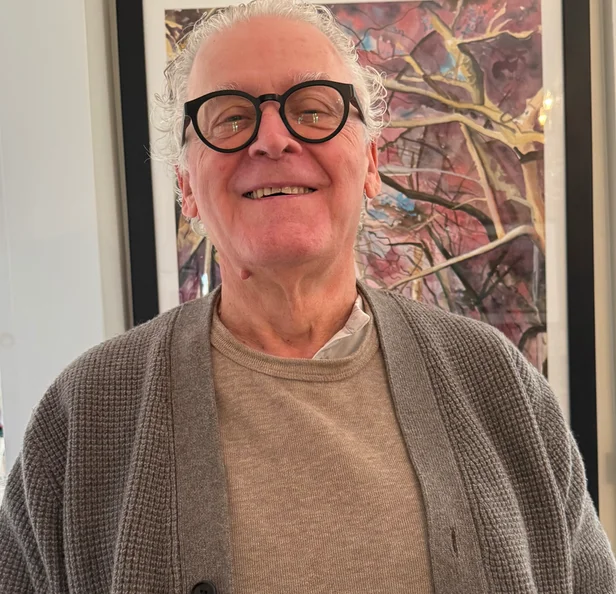
If you did that in Lambertville, and substituted “writing a screenplay” with “creating a painting,” any number of artists would turn around. One of them might be Mark Oliver, a painter, and a resident of Lambertville.
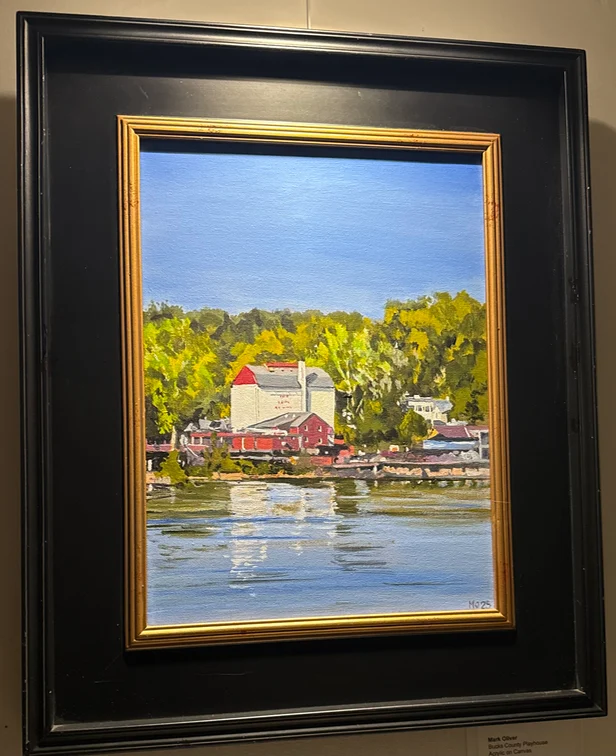
The scenes painted in artist Mark Oliver’s expansive oeuvre span from the seascapes of Holy Island, Lindisfarne, England, to the cafés of Paris, France; from the elaborate bridges of Newcastle, England, to the newly painted buildings of Tribeca, New York; from a hardscrabble-looking luncheonette in Lambertville, New Jersey, to a pastry shop in Lisbon, Portugal. Wherever he travels, capturing images for his painting is foremost on his mind.
(Mark is too self-effacing and modest to use the word oeuvre about his own work; it’s my word, and I use it as often as possible.)
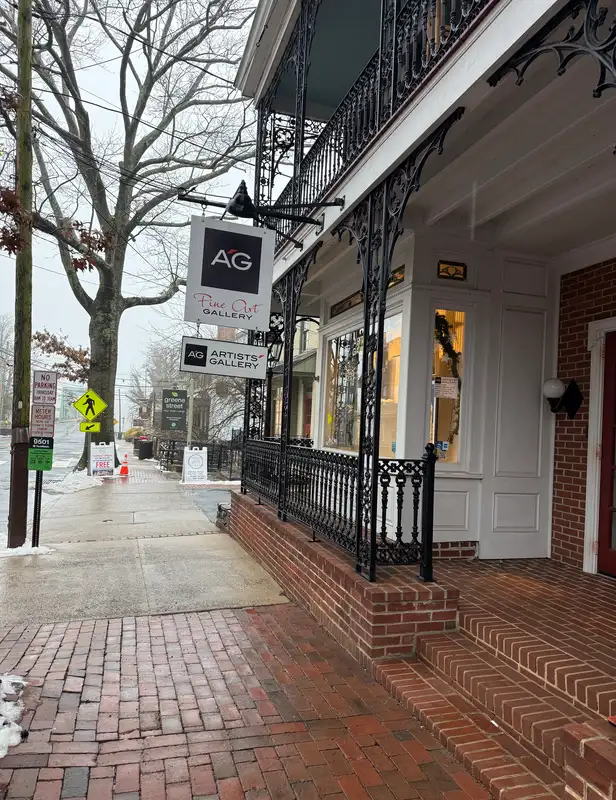
His paintings—some of which are on display at the Artists’ Gallery on Bridge Street in Lambertville, a collective of artists who work at the gallery a couple of days a month and pay rent in exchange for showing their work—are often of the intricacies of buildings and streets, as Mark was an architect in New York City for many years.
We sat for our first interview session in the green comfy chairs at Luminary Coffee, a café and roaster's at the northern end of Lambertville’s Union Street. It’s a large space and has, usually, a mellow atmosphere. It gave us the space and quiet to speak undisturbed for close to an hour. The café was at one point a car repair garage.
*
The reason I wanted to write a profile of Mark was because I admired his paintings. As a non-artist, I’m interested in what makes you an artist and how does your family history, school experiences, and artistic prowess lead to something you do throughout your life.
*
Mark remembers his childhood fondly. Born in the northeast of England, the oldest of three children—his mother had them all before she was 21—Mark had a “very, very happy childhood,” he says. “We obviously didn’t have any money, but we never knew that. Life was idyllic.” He and his siblings played games and rode bikes with the Stevenson family across the street, whose two kids rounded out their “gang” of five.
“There was always a group of kids to play with,” he says, “and always a game going—whether it was a football game or a cricket game or a game that you call stoop ball here. We also played a game in which you guard your own gates. My childhood was active and outdoors, a constantly moving childhood. It was great.”
Though he doesn’t keep in touch with friends from school and town, Mark will occasionally bump into to them when he visits. Things haven’t changed very much. “The town is very Catholic-Protestant,” he says. “There’s a Protestant-Conservative Club, there’s a Catholic-Irish Club.” When he was a kid the men had all the seats at the bar. “Now their sons are sitting in those seats. And they all know what I’m doing and I suppose I’m the one who got away and lived in New York. I’m sure they say, ‘I have a friend who lives in the states. I went to school with him.’”
Mark likens his native town to the setting in a James Joyce’s novel.
“It’s, you know, Ulysses, that whole gang of people milling around and going in town. I identified very closely with the people I grew up with and the characters in Ulysses. I thought they all interacted and knew each other. It’s that small town life.”
*
I met Mark and his wife Judy, a retired educator, and a formidable baker, for the first time at a garden party in Lambertville a few years ago, and the most unlikely of things happened. It was a lovely, spring evening, and we had settled into our chairs with our drinks, a plate full of hamburger and salad resting on our laps. Our conversation went something like this:
Judy: We lived in Park Slope, Brooklyn before moving to Lambertville.
Me: Oh, really? I taught in Park Slope.
Mark: Where’d you teach?
Me: Middle School 51
Judy: That’s where our son went. What did you teach?
Me: 7th grade English, at MS 51
Mark: Do you remember our son, Pete?
Me: (Sheepishly.) No, I’m afraid I don’t.
Judy: Let me call him right now. (She calls, speaks with Pete, and hangs up after a minute or so.) He had you for English in seventh grade!
Me: Well, let’s consider this a belated parent-teacher’s conference, then, with the advantages of beer to soften the edges.
*
When he was eleven-years-old, the trajectory of Mark’s life changed. He grew up in a very blue collar, working class family in Hebburn, England. His family was Catholic and very religious. An altar boy from a young age, he would go to church before going to school. In fact, the church was right next door to the school.
Sometimes he would get pulled out of school for a wedding or a funeral and go to the church and be an altar boy. He’d get 10 shillings for that. Once, he remembers, there was a famous ship built in his town, called the HMS Kelly.
“Lord Mountbatten, if you remember him, who was shot by the IRA, was the captain of the ship. But he was a real cowboy. It was torpedoed like five times, apparently. And all the men [who were killed] are buried at a grave in our cemetery. When I was a kid, people died and were buried there—and received a ten-gun salute. I remember being an altar boy, and not realizing the guns were going to go off. I’d do a split—falling to the ground.”
*
Since he was the oldest in his family, it was expected that he’d become a priest.
“I have this uncle,” he says, sipping his coffee, “who was a missionary priest in Nigeria, my father’s brother. My family wanted me to become a priest. Somewhere, I must have thought so, too. I was obviously the smart, oldest child. Very religious, very, very religious upbringing. Went to church religiously—every Sunday. I was an altar boy. I would go to church before I went to school. So, at eleven-years-old, I went to a Catholic Seminary.” It was essentially a boarding school. “It changed my entire life, because I got an absolutely fabulous education. You know, Latin, Greek—the whole thing.”
Mark points out that it was good for him because he comes from the Northeast of England, where they have a very distinctive accent. In Britain, your class is identified by your accent.
“Oh, yes, absolutely,” Mark says. “Your socioeconomic character—everything about you, down to your accent, and mine was definitely working class.”
He learned to navigate the vagaries of elocution and, with it, the culture of school life—and learned something significant about himself.
“So I got to the school, which modified my accent somewhat, but it also showed me that I was smarter than the kids from wealthy families from the south and wherever. So it gave me a lot of confidence. I got a really amazing education from the seminary. Obviously, I lost whatever beliefs I had when I was there. I’m the most irreligious, most atheistic person. I don’t believe in any God whatsoever.”
He’s been away from home since he went to school, but it’s never been a big adjustment for him. “And I mean, I love my family. I go back and see them all the time,” but he never got homesick. “Wherever I am, I make the most of it,” he says.
*
Mark discovered his affinity for drawing in a science class at the seminary. He remembers that it was biology and there was a request from the teacher to draw an animal.
“I just got this incredible vision of it. I must have been reading a book on foxes or something, but I got this really clear picture, and I drew it, and it was fuckin’ good.” It was that fox in the science class that was the genesis of his artistic career, and from that moment he would spend every spare second drawing. However, he felt inadequate in most of the subjects he studied In school. That’s why he says he went on to become an architect, because architects are often called “jack of all trades, master of none.” The only thing that he found he was really good at was drawing. “And that’s what took over my life when I was about 15. I spent every spare second sketching and drawing.”
Initially he went to university to study classics, Latin and Greek, but decided that wasn’t the right path for him, choosing instead to become an architect. Architecture was a different animal back then.
“We learned ,” he says, “the old-fashioned way. When I started: it was ink on vellum, which is the same way they did the illuminated manuscripts in the seventh century. But when I came here, to America, studying at Pratt in New York, it was pencil on mylar. It was a lot easier.”
He learned how to set up a drawing so that you start in one corner and work your way to its conclusion, so you don’t smudge it. You begin with a plan, thinking how the drawing is going to be, get it all the way through the perspective sketches.
“Most of the stuff I did was commercial interior. So it was a bit boring. But most architects, I’d say, are not very good drawers, sketchers. They may be good at architectural drawing but that’s it.”
He designed conference rooms, office spaces. Sitting back in his chair, he says, “I mean, 99% of architecture, it’s just commercial shit. The ‘starchitects,’ doing fancy buildings are maybe one percent. And even in architectural firms, 90% of the employees there are just production people.”
The designers are maybe 5% to 10%, he says. “So, it’s not a particularly artistic field.”
When I ask Mark if being a architect has transformed the way he see things in the world, he says, “Oh, I definitely notice things that most people don’t. I remember distinctly being on a train in a subway, an underground in London, and it came out of the ground and you were above the roofs of the houses around. And I remember looking over and thinking how are they going to get the water to gutter and make the rain come off those roofs, ‘cause they all looked a bit like water wouldn’t go anywhere. That’s definitely an architect’s view—nobody else would care about how they’re going to get the water off the roof.”
*
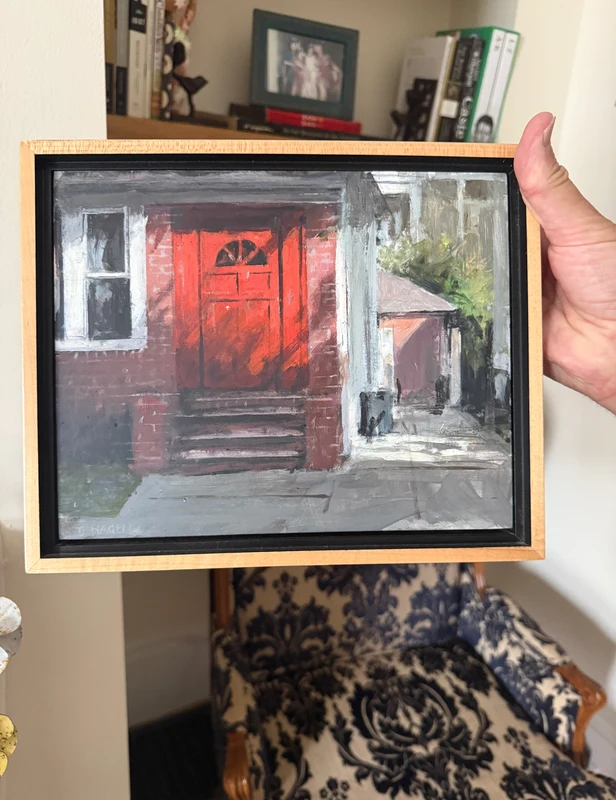
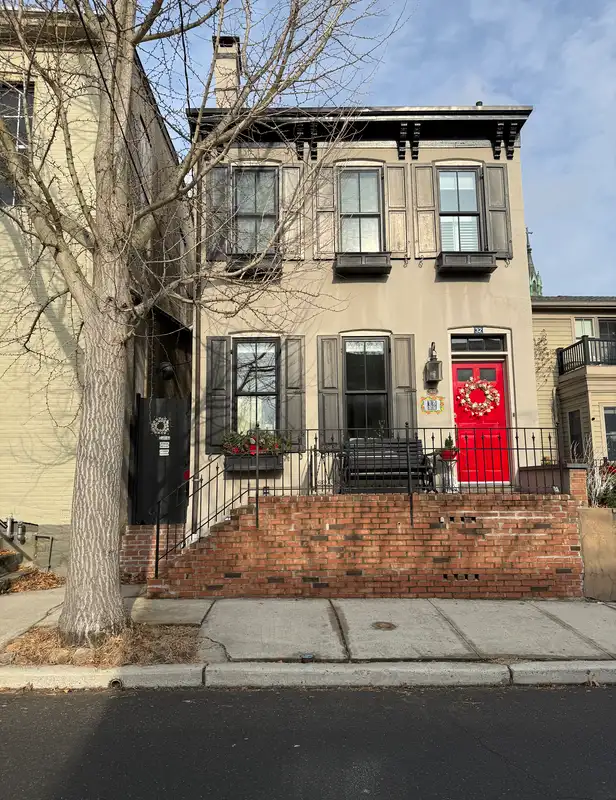
The next day, I went to Mark’s home in Lambertville, with its brick facade and red door. His paintings adorn the living room, dining room, and kitchen, as well as the upstairs bedrooms. But he didn’t discuss his paintings at first, telling me instead about a small painting he had by an artist friend.
“This is a piece,” he says, “by Tom Hagan, who was one of the members of Brooklyn Waterfront Arts Coalition in Red Hook. He and his wife, Anna, were really big supporters of mine and they helped me get my start.”
With the help of Tom and his wife, Mark began exhibiting in 2000. “I’ve always wanted to support his art,” Mark says, “and since we’ve always had a red door on our house, it seemed perfect. He’s a very talented painter. I like his style.”
When I ask Mark the reason he’s always had a red door on his houses, he replies, “It’s one of those things; we’ve just always had a red door.”
Following Mark through his home is akin to taking a tour of a museum, where the images on the walls reflect the breadth of an artist’s career, as well as its longevity. After speaking to Mark about his work—and his explaining the different stages of development for each piece—it seems, to me, a non-artist, as though each painting has its own DNA: with its inception, most likely in his sketchbook, or from a photograph, the decision of the perspective he’ll use in the cumbersome task of outlining it, and what medium he’ll chose to render it in—acrylic, oil, or pencil—and how and when he decides it’s finished. It’s more than just a process.
Paul Ilechko, a friend of Mark’s and mine, who himself is a painter, has a different take on Mark’s practice. “The thing I really notice about Mark’s work is that he is able to take the accuracy of line from his architectural background and merge that with a natural feel for color and texture that only comes with being a true artist. He’s not just coloring in drawings he’s really painting but with an impeccable underlying structure.”
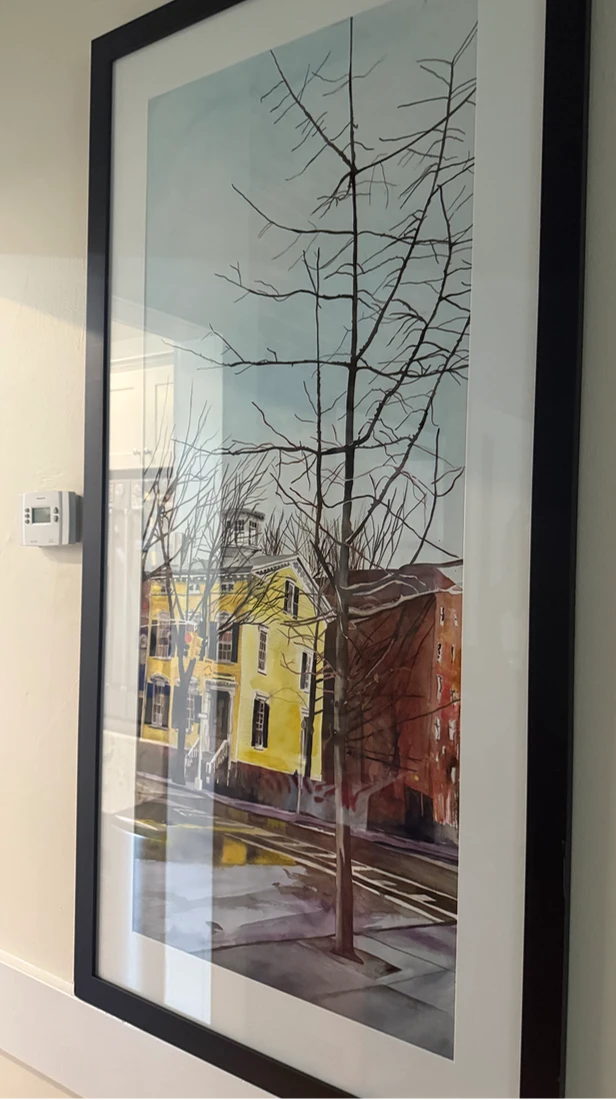
Mark painted the house, above, multiple times because it’s near Pratt, where he went to school. One of the things he’s most happy about in the painting is the way the puddle of water in the road reflects the apartment building. I can’t even imagine how someone would accomplish something like that. How are painters able to capture scenes so true to life?
“For all of this painting,” he says, pointing to it, “this is the piece I love.”
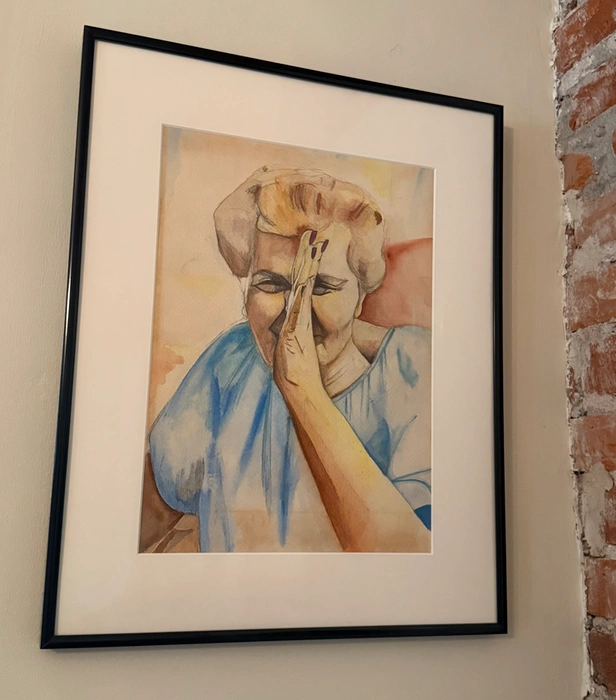
When we come to the painting of Judy’s mother, Pearl, who has her hand in front of her face, I ask Mark the reason she places her hand there. He casually says, “She’s funny… That’s what she did all of the time.”
I wondered what it meant.
“It means, ‘Oh, fuck you,’” he says. “Same as the Three Stooges.”
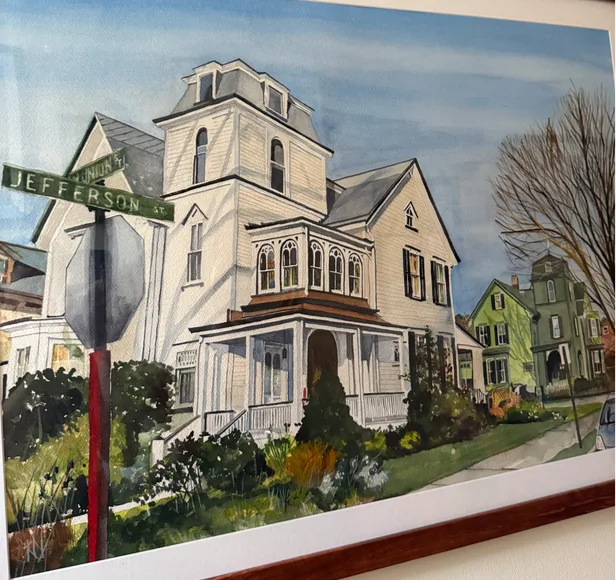
“The two guys who live in the house,” Mark says, “saw this painting and didn’t want to buy it.” He didn’t know the reason they didn’t want to purchase it.
We climb the stairs to the second floor of the house.
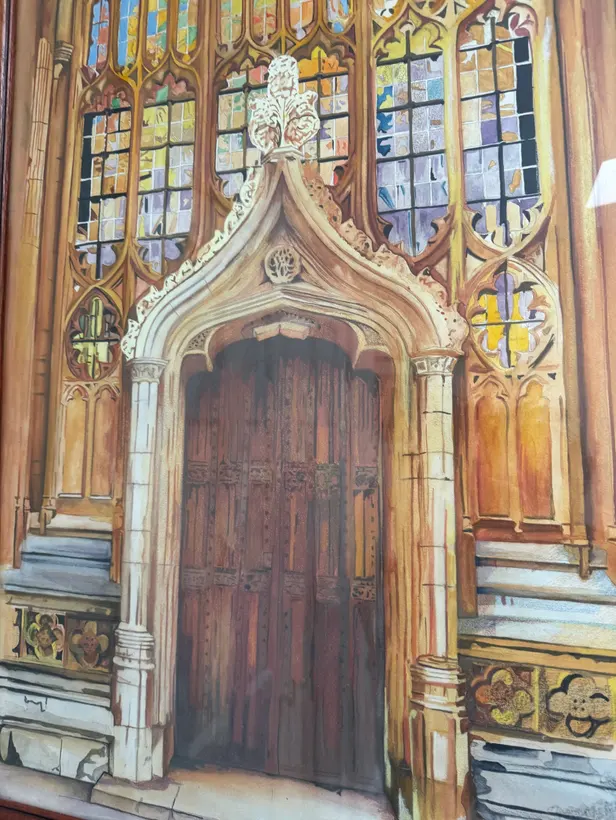
“This is the Bodleian Library in Oxford,” Mark says. “And you can see the open little book above the door. I’ve done this multiple times as well. I did this when I was finishing up at Pratt. It was for a course; I think I got an A on it. It’s really nice that one. I like it a lot.”
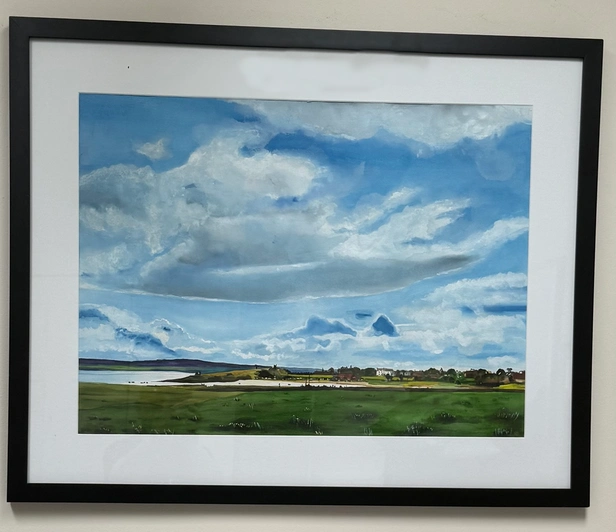
This is one of Mark’s favorite places in the world, a place called Lindisfarne on Holy Island, on the Northumberland coast. “It’s where monks established Christianity in England, from 5th, 6th century.” It’s where they now make mead there. “It’s a causeway: so when the tide’s in, it’s an island, when the tides out you can walk over. Even Judy likes it. It’s just a magical place. So much history to it.”
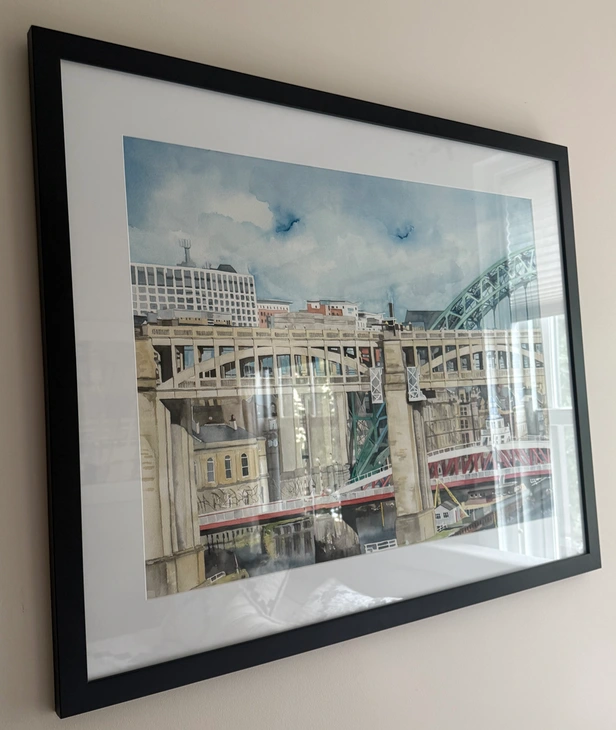
This is the town of Newcastle, which is famous for its bridges.
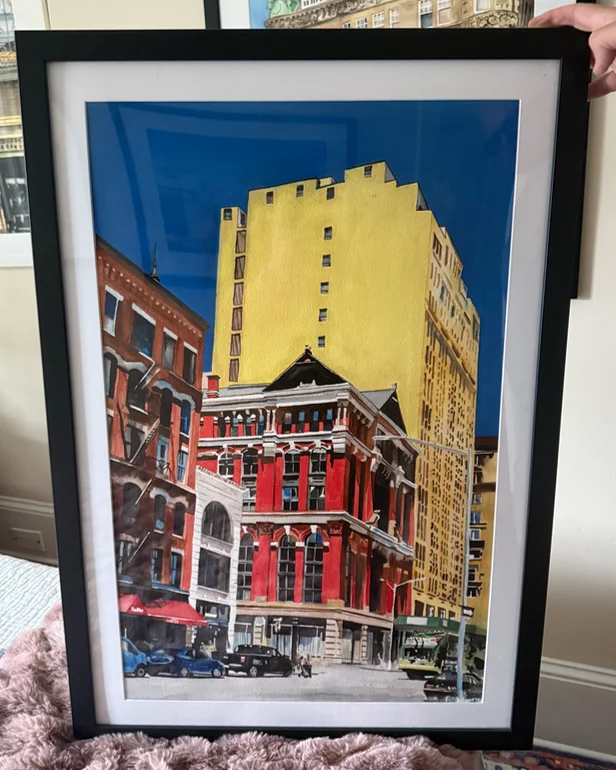
This is one of Mark’s favorite pieces, as well, an intricate look at several of Tribeca’s buildings. Mark enjoys its colors. “I like the blue, yellow, and reds,” he says.
There is something that’s very appealing about Mark’s paintings—and one of them is his use of color.
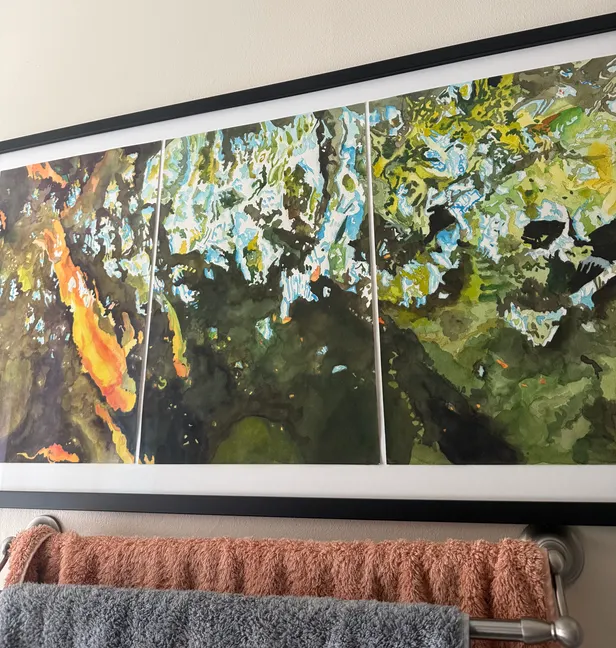
From his oeuvre, this seems a very different kind of painting for this artist.
“Fish in a pond,” he says. “Went for triptych, you know, reflections in a pool.”
We clomp up steep stairs to his studio, where a mélange of paintings and tools of the artist’s trade await us, as though an audience preparing to watch a performance. I wonder aloud what Mark feels when he paints; why does he like it so much?
“It’s almost like I have to,” he says. “It’s like breathing. It’s like I have to do it. It’s a compulsion. There’s no wanting to do it. There’s no desire so much as I have to. I have to feel I’m doing something.”
Things change for him when he leaves the realm of day-to-day creating for a vacation.
“When I go away, I get guilty for not doing it,” he says. “I’ve got to paint. I just got to draw. I just got to do something. You know with retiring, in quotation marks, I’m busier now than I ever was working. Retiring, I feel like I’ve got a couple of years to churn out stuff that’s been built up from having to work and not having a chance to.”
Working in retirement has given him a sense of freedom, which has enhanced the variety of paintings he does. He strives, these days, to develop new techniques.
“When I was working and had a limited time to paint, I was much more conservative and not a very daring artist, because you don’t want to waste time doing something that’s a mistake and you’ve got to throw it away. So, now, I’m starting to do more acrylics on canvas, I’m trying to sometimes do funkier things.
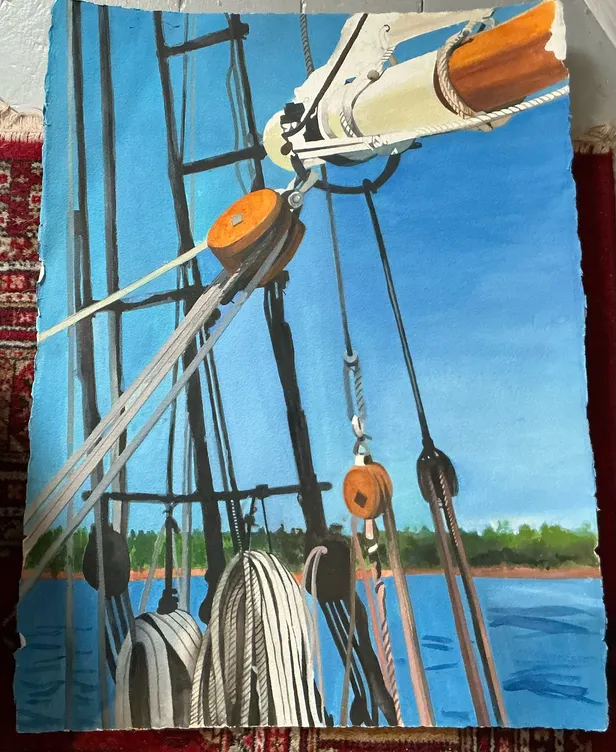
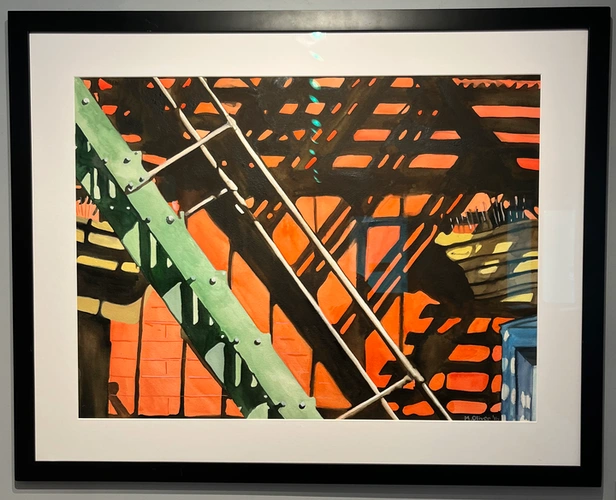
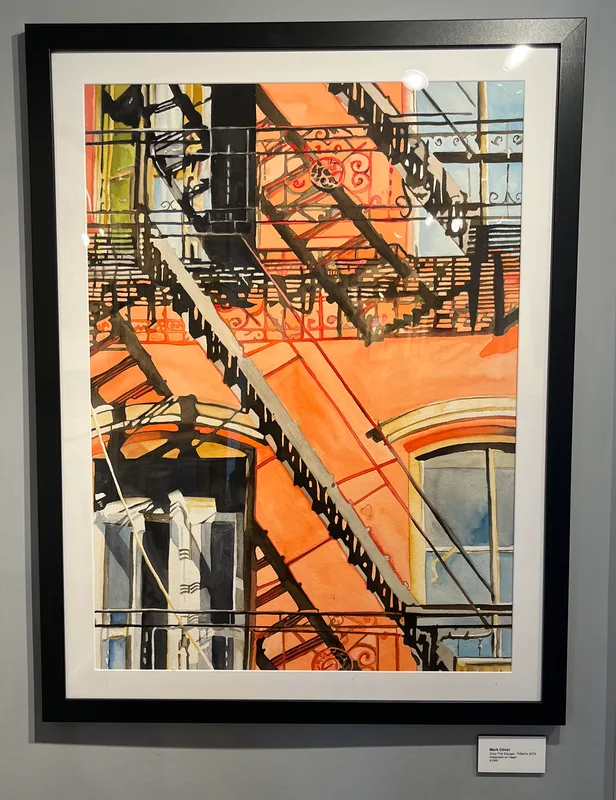
He has several different paintings of fire escapes, and I wanted to know their allure for him.
“Somebody,” he says, “once said, they’re like Superman’s underwear. Because you know they should be on the inside but you’ve just gotten used to them on the outside. They’re staircases; they should be inside. It’s an American thing. You don’t see these in Europe. You don’t see fire escapes. ‘We’re going to build a building—oh, shit how are we going to get out in the event of a fire? Okay, let’s stick a staircase on the outside.’ You know, it’s stupid.”
He goes on to remark about the exterior of a building, that it’s kind of like a canvas itself throughout the day.
“The thing about a facade of a building is that in the morning, it gets morning light and the light changes. They’re constantly changing and you got a sculpture on the outside of the building that’s continuously moving. It’s never the same. you can walk by at 10:00 in the morning it’s that way, but at 3:00 in the afternoon it’s something completely different. That’s where the fascination is. It’s that constant—completely alive. It’s different on rainy days and sunny days, it’s different on cloudy days. It’s different all of the time.”
Mark loves fire escapes. When he’s bored and not sure what to do, he’ll dig out a photo of a fire escapes and sketch it. “It just keeps me lubricated. It’s good I have something that you always go to.”
And then he asks me, “Is there something that you write about and always go back to?”
I don’t realize it until after our interview, but it’s true. My writing always seems to come back to my mother—and growing up in Queens, New York.
When using acrylics, he’ll work at his easel. But if he’s working on a watercolor, he’ll work at his desk. He paints each day from around 8:30 in the morning until 2:00 in the afternoon.
Mark has many sketchbooks. They sit, one on top of each other, on the red oriental rug in his studio. Some notebooks are red and some are black. The details in them are intricate and well-rendered.
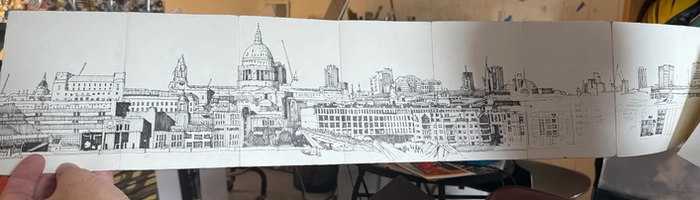
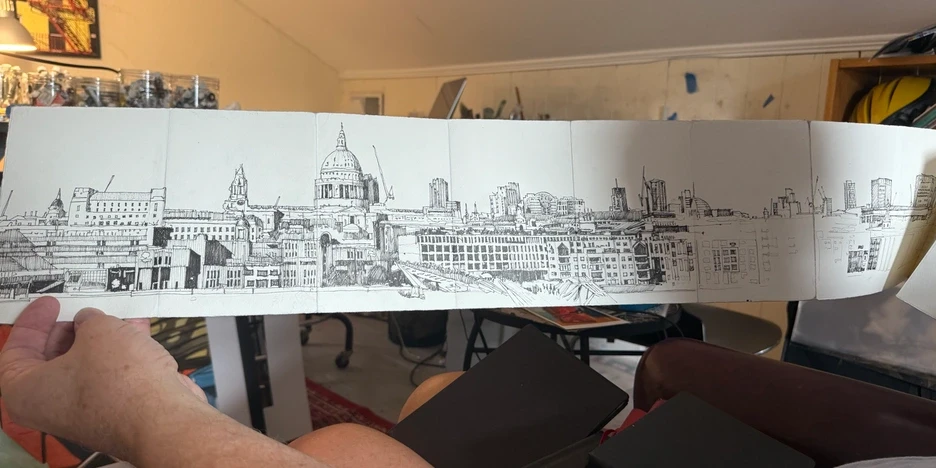
He unfolds a long paper from one of the notebooks. “This is an interesting one,” he says, holding it up before him. “I started it in London when we were on vacation there. It’s St. Paul’s. I started sketching there but ended up taking pictures.
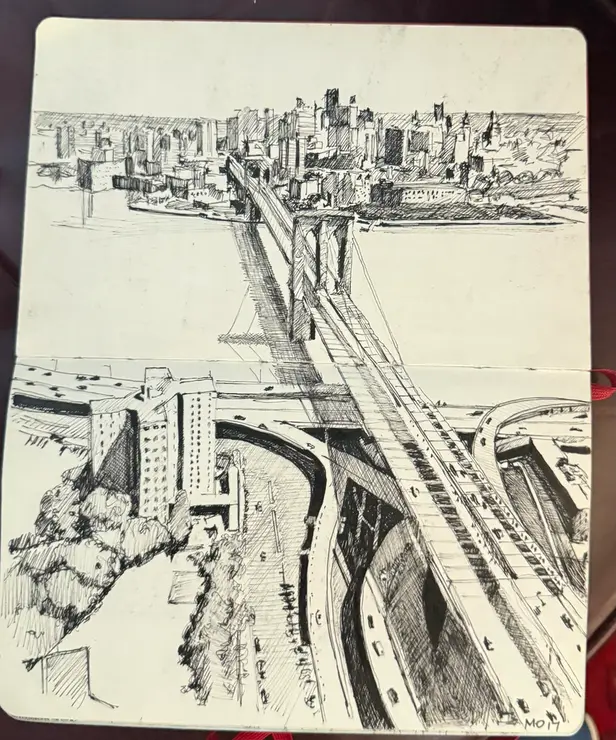
“I did a couple of things for New York City. We worked on their buildings that they had right by the Brooklyn Bridge.
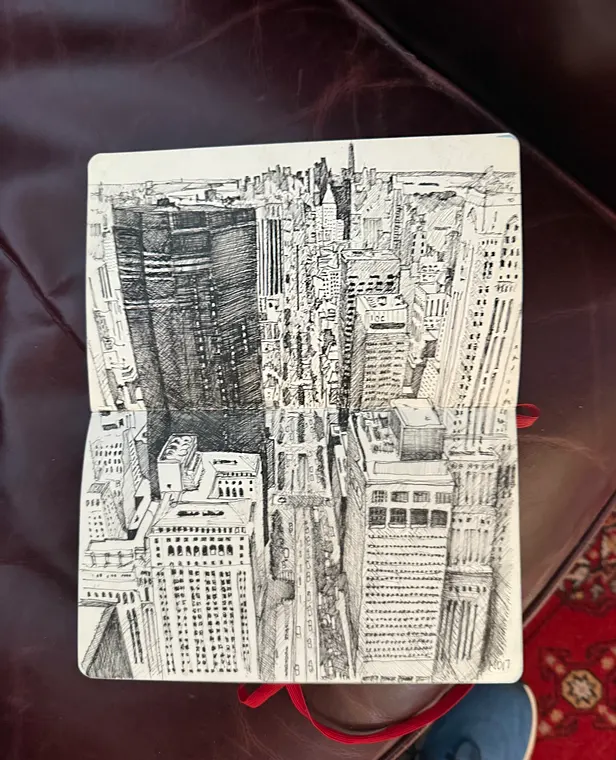
This sketch in his notebook was started on the subway in New York City and finished at home.
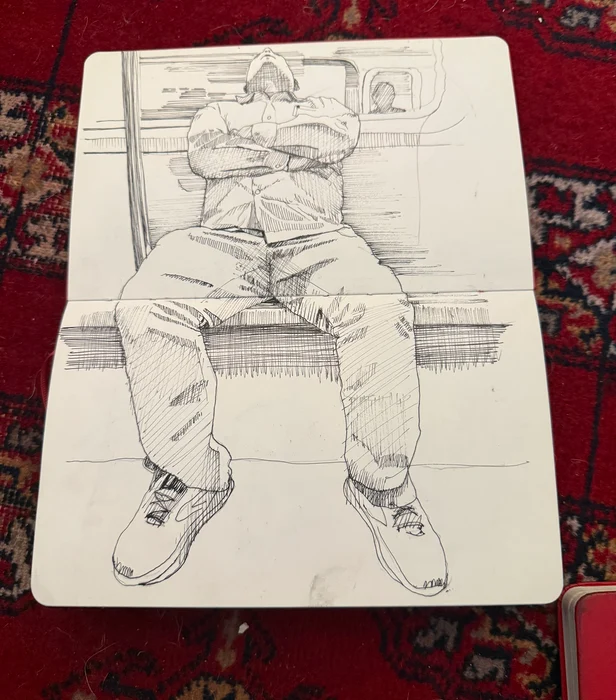
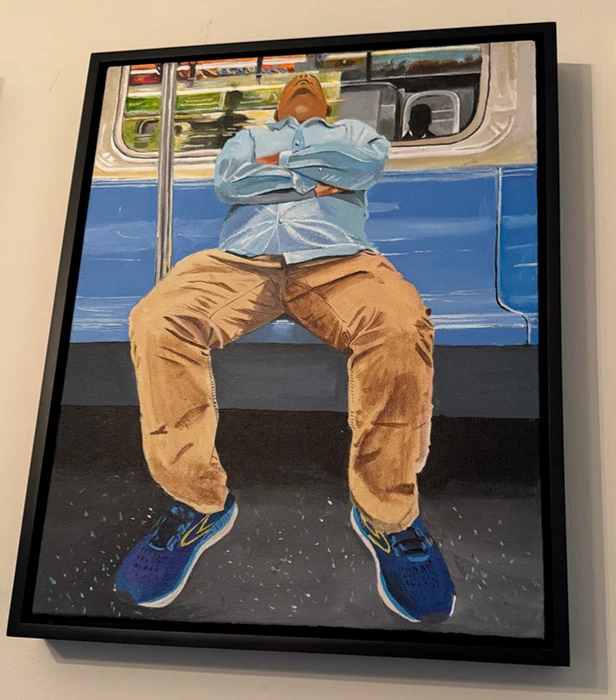
This is Mark Oliver’s art world.
As for the future of his work, he’s going to stay true to “urban landscapes, as well as architectural-based pieces. You know, buildings are where my niche is and where I’m happiest.”
*
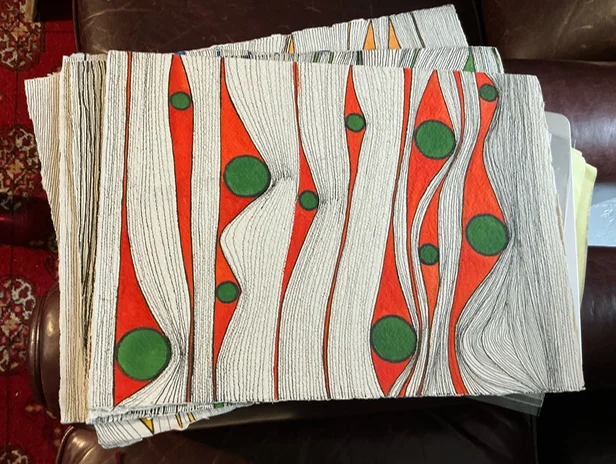
Lately, however, he’s been experimenting with something new. Using his notebook is extremely important to Mark and integral to his process. He often doodles in his notebooks. For the last thirty or forty years, his go-to doodle is to draw circles on a page and then create lines around it.
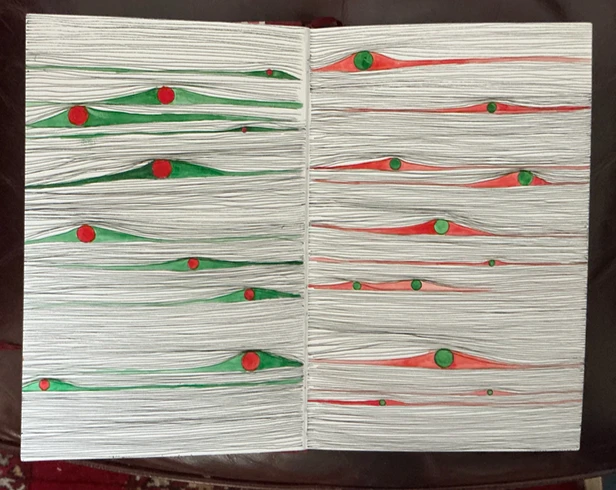
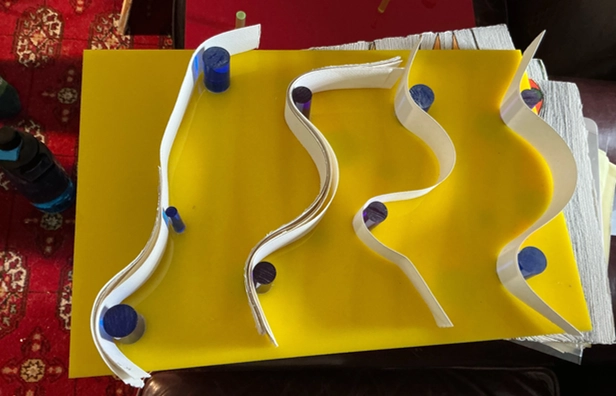
“A couple of weeks ago,” he says, showing me the notebook, “I was thinking, ‘those would be nice as sculptures.’ So I went to Canal Plastics in New York City and bought some plexiglass sheets and some tubes. I’m making a sort of sculpture thing of my notebook, so there’s a direct correlation between what I’ve been sketching and the sculpture. Sometimes, but not always, there’s a definite linear path between what I put in a notebook and what I create, such as a painting or a sculpture.”
*
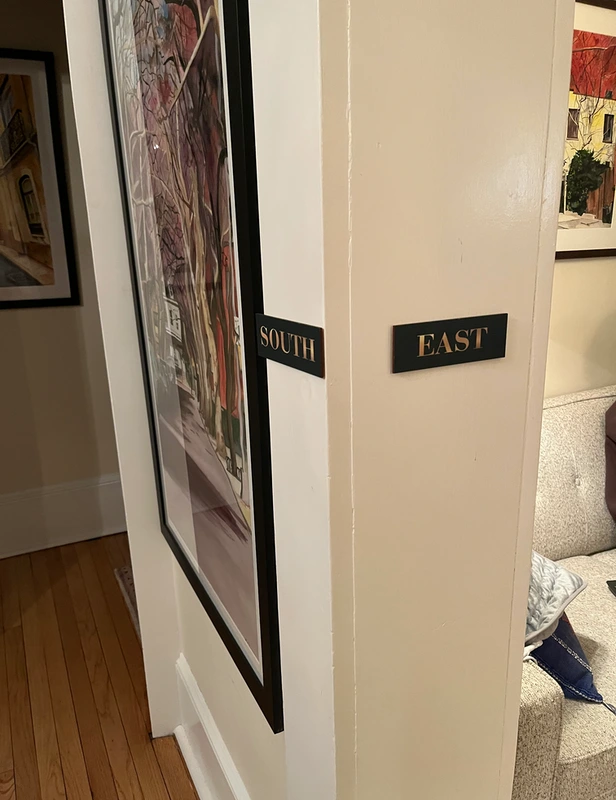
Finally, as I was leaving I noticed signs on some of the walls: North, South, East, and West. Mark explains, “There’s a museum in London,” he says, “called the John Soane’s Museum. He was an Architect. And he designed the Bank of England. And it’s a wonderful museum and it shows how crazy the mind of an architect really is. And the [cardinal points] was one of the things he put in his rooms to orient people, which is north, which is south, which is east, and which is west. So we bought them at the museum.”
To me, this seemed a perfect metaphor for the life of this painter: he travels widely but is grounded in the town of Lambertville.