Selma Burke’s Ten Cents: The Legacy of a New Hope Sculptor
This blog post can be sponsored by you. Display your link and message here to be seen by local residents and Lambertville area visitors—permanently.
The Bucks County artist best known for sculpting Franklin Roosevelt’s profile is being honored in a show at Phillips’ Mill.
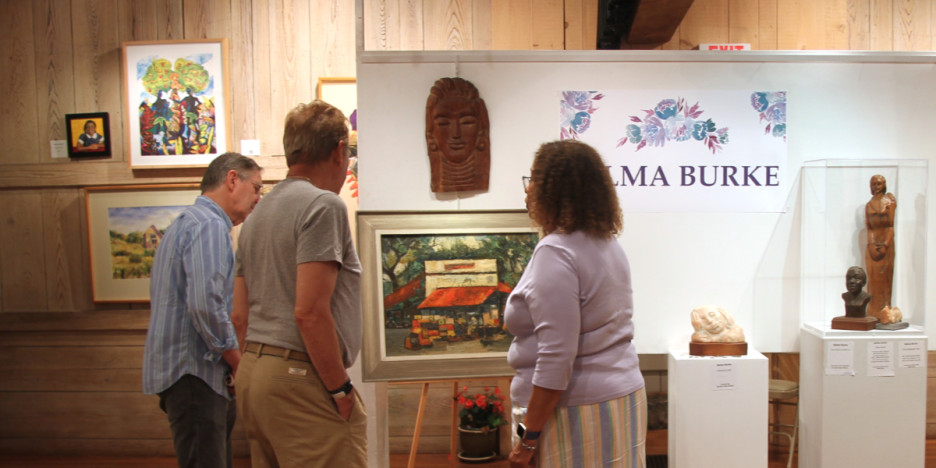
The Selma Burke Invitational African American Art Show is on display now in New Hope, gathering together an intimate collection of some of the artist’s more portable sculptures along with works by other African American artists.
Burke made her home in Bucks County for the last 45 years of her life, arriving in Pennsylvania after she’d already made her mark in Paris, Vienna, New York, and DC. In 1943, six years before moving to New Hope, Burke won a national contest for a commission to create a large bronze portrait plaque honoring President Franklin D. Roosevelt.
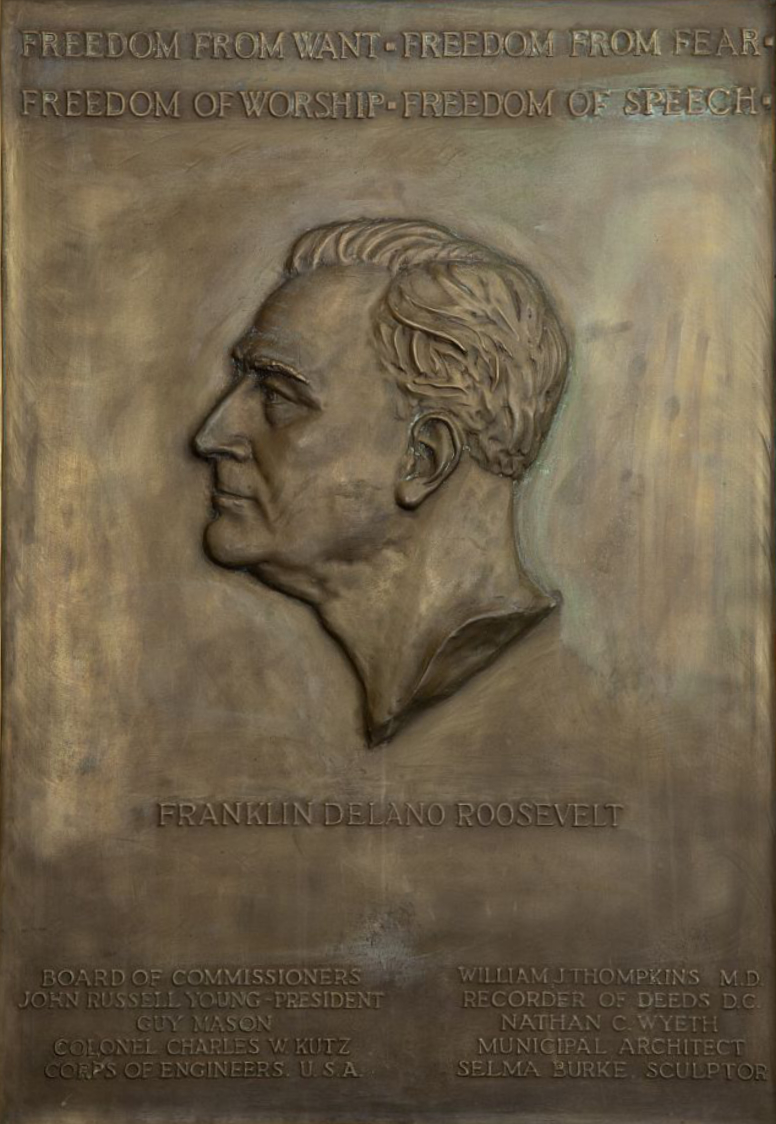
Upon receiving the commission, the artist wrote to Roosevelt to request a live sitting so that she might sketch the President herself. The portrait Burke created conveys the dynamism she must have witnessed in her two meetings with FDR. Though she depicted him in bas-relief—the sculpted profile barely projecting off the flat plaque—Roosevelt appears to have his head cocked, seemingly intent on carefully observing the world around him.
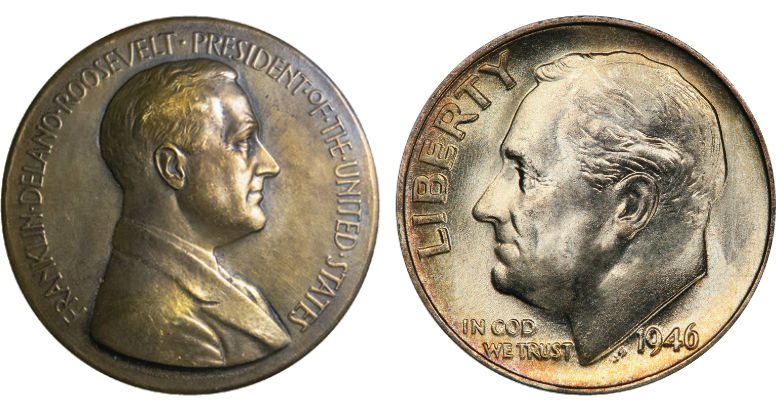
There’s some debate about whether or not Burke’s artwork, which has been on display at the Recorder of Deeds Building in Washington since 1945, inspired the depiction of FDR on the dime. John Sinnock, the Chief Engraver of the US Mint from 1925 to 1947, is the officially named artist of our ten cent piece, and every coin is signed with his initials. That said, the dime design differs from Sinnock’s previous bas-relief portraying the President on his inaugural medal of 1933, with the coin having something of the liveliness of Burke’s profile plaque.
We probably won’t ever untangle the inspirations that led to our ten cent coin, but one thing is for sure: you and I may have our two cents to share on any given topic, but Burke always had at least ten. The sculptor founded multiple art schools and influenced many artists in her time. The Selma Burke Invitational African American Art Show at Phillips’ Mill celebrates that legacy.
Kimberly Camp, who is the recipient of several National Endowment for the Arts grants as well as being the former president of The Barnes Foundation and the founding director of the Smithsonian Institution Experimental Gallery, met Burke many times at events coordinated by the National Conference of Artists. The Philadelphia chapter of this organization of Black American artists was active in those days, and Burke would sometimes come to exhibitions or other programs.
Camp describes Burke as “very gracious and very generous with her time with us young whippersnappers who didn’t know half of what we were doing.” Burke even shared about her encounters with FDR, explaining that she sat on the floor to sketch the President so that she might understand his face from every angle. This is doubtless one of the keys to the fullness and vibrancy of Burke’s famous bas-relief portrait.
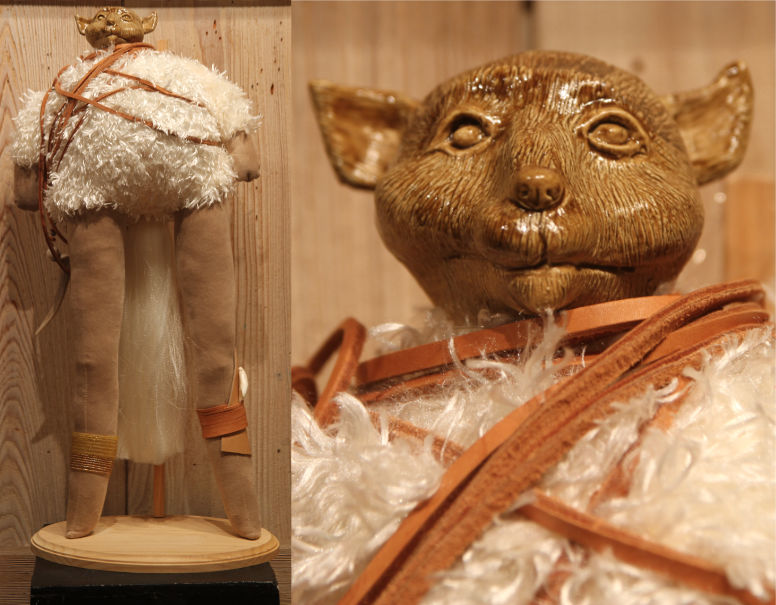
Camp herself is also a three dimensional artist. The Collingswood-based creative makes dolls, using clay, fiber, beads, and sometimes metal armatures to invent extraordinary figures. Pigey is one of three dolls included in The Selma Burke Invitational African American Art Show. The artist explains that, as the 2015 Presidential campaign started heating up, she found the need to start working with heavier materials. Camp had been using paper clay, but she pivoted to stoneware, because she liked that the medium needed to be “pounded and smacked and rolled.” She would make a batch of animal heads and feet, and once the stoneware was cured and fired, she’d tuck the piece away for a time. The artist says, “my process is that when I’m ready to make a doll I look in the box of heads and all the parts...and see who wants to go first. Each one of them tells me what they want to be as I’m making them.”
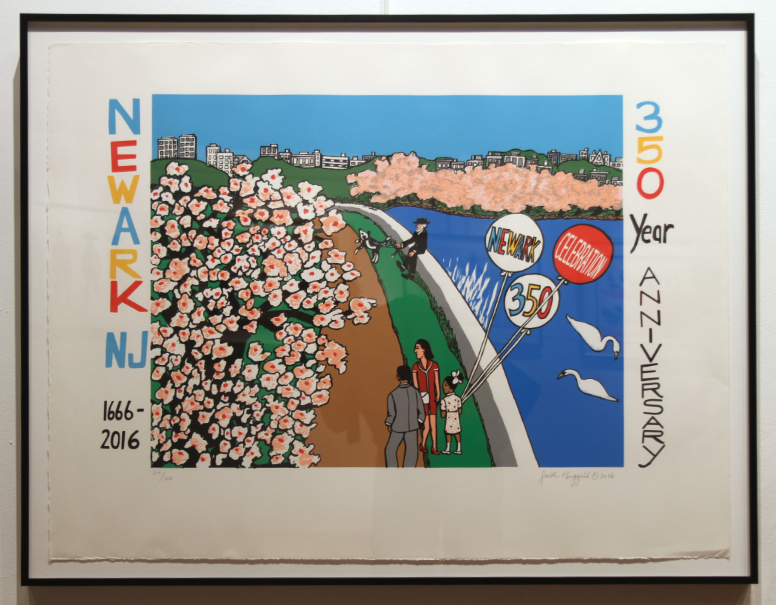
Faith Ringgold, who passed away last year after a rich career spanning seven decades, was a multidisciplinary artist known especially for her paintings and story quilts, but she created dolls as well. In fact, Camp told me how Ringgold came across her work in a show organized by the Women’s Caucus for the Arts in 1983 and fell in love with it. A few months later, Ringgold connected Camp with an editor at Essence magazine who was putting together a story on dolls.
The artwork by Ringgold currently on display at Phillips’ Mill is a commemorative print based on a painting commissioned to celebrate Newark’s 350th anniversary in 2016. This piece is in keeping with a role Ringgold embodied beautifully, that of artist as storyteller. That said, its tone is more celebratory than some of her most famous works, which often addressed challenging themes, including racism. For example, in 1969, in response to the image of the Apollo 11 moon landing, Ringgold created Flag for the Moon: Die Nigger, an oil painting of the American flag in which her message is spelled out subtly, overlaid on the stars and within the stripes themselves as a commentary on the very fabric of our nation.
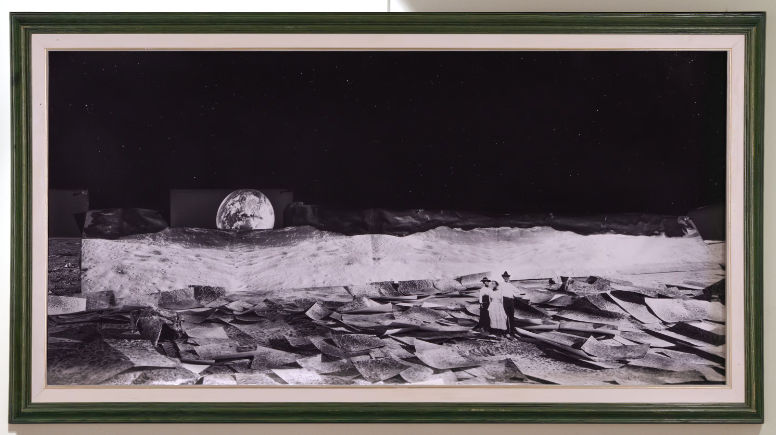
Ron Tarver, a staff photojournalist at The Philadelphia Inquirer for over thirty years and the recipient of Guggenheim and Pew Fellowships, also explores the idea of humans on moon in Homesteaders. This constructed image is part of an ongoing series entitled An Overdue Conversation with my Father. It includes imagery pulled from photographs and negatives produced by the artist's father, Richard Tarver, in small-town Oklahoma at a time when Jim Crow laws were still in effect. Though The Selma Burke Invitational African American Art Show as a whole is a fascinating exhibition, it’s this image by Tarver that stays with me. It evokes the idea of Black frontierspeople having to go to the moon to find land as well as a dream of a place where these pioneers might be able to make a better world, completely from scratch.
Be sure to catch this wonderful exhibit, a beautiful homage to Selma Burke and Black art. It’s on display Saturdays and Sundays, from noon to 5 pm at Phillips' Mill, across the river from Lambertville at 2619 River Road, in New Hope, Pennsylvania. Admission is $7 for the general public and free for Phillips’ Mill members, and the exhibit runs through June 29th.